×

Plan ahead and save up to £200 Save up to £200 on selected funeral plans until 31 October. T&Cs apply. Click here for full details.

Two Together: Save £100!Save £100 when you purchase two funeral plans together. Call us for more details.

Written by Emily Cross.
20 minute read

Funeral poems can offer comfort and help you find the right words to say goodbye to someone you love. From short, heartfelt verses to uplifting readings that celebrate a life, the right poem can express love, grief and cherished memories in a way that feels personal and meaningful.
When someone you love dies, putting your feelings into words isn’t always easy. You may want to honour their memory, reflect on the moments you shared or find something that brings comfort to those attending the funeral. Sometimes, a poem can say what you’re struggling to express yourself.
Poetry has long been part of funerals across the UK, whether read aloud during a service, included in an order of service or shared at a more personal gathering. There’s no right or wrong choice. What matters most is finding words that reflect the person you’re remembering and the relationship you shared.
In this guide, we’ve gathered a selection of beautiful funeral poems, including traditional, modern, uplifting and non-religious readings, alongside heartfelt verses for different family members and loved ones.
Key takeaways:

Whether spoken during a eulogy at a cremation ceremony, printed in an order of service, or shared in a quiet moment of reflection, poetry in British funeral tradition has the unique ability to capture love, loss, and the memories that remain.
Poetry has a way of reaching straight into the heart. At funerals, it helps us:
Finding the perfect poem depends on:
If you’re considering including a spoken or written message in the service, exploring a few funeral tribute examples and eulogy examples can be a helpful place to start. Whether it’s a heartfelt eulogy, a short note printed in the order of service, or a shared memory during a more informal farewell, these examples can guide you in expressing your thoughts with sincerity and warmth.
Some funeral poems have stood the test of time, and for good reason.They’ve been read at thousands of services because they offer timeless words of comfort. Here are a few favourites:
“Do Not Stand at My Grave and Weep”
This poem is often chosen for funerals because of its comforting message about love and presence beyond death.
I am the sunlight on ripened grain, I am the gentle autumn rain.
This line beautifully expresses the idea that our loved ones remain with us in the world around us.
“Funeral Blues”
He was my North, my South, my East and West,
My working week and my Sunday rest.
This powerful line captures the sense of loss and longing after losing someone dearly loved.
“Remember Me”
This poem expresses a gentle request to be remembered with love, while also acknowledging that life must go on. The comforting tone reassures mourners that it’s okay to move forward, even while holding onto memories.
Remember me when I am gone away,
Gone far away into the silent land.
Not every funeral poem needs to focus entirely on sadness. Uplifting funeral poems can celebrate the happiness, love and memories someone brought into your life, making them particularly fitting for a celebration of life or a less formal farewell. Here are a few examples:
These poems acknowledge loss while encouraging those left behind to remember a life with warmth and gratitude.
If humour was an important part of your loved one’s personality, a funny or light-hearted funeral poem can feel much more fitting than something solemn. These poems can bring a welcome smile and help a funeral or celebration of life reflect the person as they really were.
Popular choices include “The Life That I Have” by Leo Marks or humorous verses written specifically about the person who has died. You could also write your own short poem based on their favourite sayings, habits or shared family jokes.
Humour works best when it feels affectionate and true to the person, rather than added simply to make the service feel less sad.
For those who find faith to be a source of comfort, religious poems and scripture-based verses can bring a sense of tranquility. A few beloved choices:
Psalm 23: “The Lord is my shepherd…”
Psalm 23 is one of the most well-known and comforting passages in the Bible. It speaks of God’s guidance, protection, and the promise of eternal peace, offering reassurance that the person who has died is now in God’s care and that their loved ones are not alone in their grief.
Even though I walk through the darkest valley,
I will fear no evil, for you are with me.
“Safely Home”
This poem paints a picture of heaven as a place of satisfaction and joy, reassuring attendees that their loved one is safe and free from suffering. It brings solace by shifting the focus from loss to the hope of reunion one day.
I am home in heaven, dear ones;
Oh, so happy and so bright!
“Footprints in the Sand”
When you saw only one set of footprints,
It was then that I carried you.
This piece is deeply comforting because it reminds us that in our hardest moments, God is carrying us. It’s often chosen for funerals because it speaks to those who are grieving, assuring them that even in their despair, they are not alone.
Some poems speak universally to grief and remembrance. They are simple but powerful, and they continue to bring hope:
If I should go before the rest of you,
Break not a flower nor inscribe a stone.– “If I Should go”
I am I, and you are you,
Whatever we were to each other, that we are still.–“Death Is Nothing at All”
Twilight and evening bell,
And after that the dark!–“Crossing the Bar”
These poems remind us that death is not an end but instead a transition, and that our loved ones remain with us in spirit.
Many praised poets have written about loss, love, and memory. Their words help capture emotions in ways we sometimes struggle to. A few examples include:
All of these poems share a thoughtful, philosophical perspective on death, offering a sense of reflection rather than pure sadness. They challenge the fear of death, and each poem presents it as something natural, inevitable, or even powerless, rather than something to be feared.
In these poems, they use metaphor to explore mortality. Death is personified as a carriage driver (Dickinson), the fading of beauty (Frost), and an enemy that ultimately loses (Donne). They suggest continuity beyond death. Whether through memory, nature, or spirituality, these poems imply that it is not an absolute end.These qualities make them powerful choices for funerals, as they encourage a sense of strength, acceptance, and even defiance against grief.
Modern funeral poems can feel more personal and conversational than traditional verses, making them a popular choice for contemporary funerals and celebrations of life. They often explore grief, memory and love in language that feels familiar and accessible. Some modern and contemporary choices include:
“Afterglow” shifts the focus from loss to gratitude, encouraging loved ones to remember the joy and love shared rather than dwelling on sorrow. It reflects modern values of celebrating life rather than mourning death.
I’d like the memory of me to be a happy one,
I’d like to leave an afterglow of smiles when life is done.
“The Dash” is reflective of modern life, encouraging people to think about how they spend their time between birth and death, symbolised by “the dash” on a gravestone. It aligns with today’s focus on personal legacy and making the most of life.
For that dash represents all the time
They spent alive on earth.
“Gone From My Sight” uses the metaphor of a ship disappearing beyond the horizon, presenting death as a peaceful transition rather than a final ending. It aligns with contemporary spiritual perspectives that emphasise continuity, presence, and comfort, rather than fear of the unknown.
She is just as large as when I saw her.
And just as able to bear her load of living freight.
These can work particularly well as modern funeral readings, whether read aloud during the service, included in an order of service or shared at a memorial. You could also choose a piece of contemporary prose or write your own short verse if something personal feels more appropriate.

Sometimes you don’t need a long reading. A few simple funeral words can be enough to express love, gratitude and the difficulty of saying goodbye. Short poems to say goodbye at a funeral can work particularly well as part of a eulogy, at the end of a service, or during a quiet moment of reflection.
If you’re struggling to find the right words to say at a funeral, these short original verses can offer a starting point:
Though today we say goodbye,
Your love remains with us.
In every memory, every smile,
You’ll never truly leave us.
We’ll miss the moments that we shared,
The laughter and the love.
But everything you gave to us
Will always be enough.
We say goodbye with heavy hearts,
But gratitude as well.
For all the years and memories,
And stories we will tell.
If you’d like to write your own poem, start by thinking about:
It doesn’t have to rhyme or be perfect, as long as it comes from the heart.
Some people adapt well-known poems by adding personal details like a favourite nickname, memory, or inside joke to make it feel more personal and meaningful. If it feels like too much to write something from scratch but you still want it to feel uniquely meaningful, this might be a great option for you.
Not every service takes place in the conventional way. Direct cremations, which take place without traditional elements such as a hearse and pallbearers, allow families the freedom to honour their loved one in their own way, in their own time. While some direct cremation services do offer space and time for an attended funeral, many don’t follow a formal structure, and families may choose to hold a small, private gathering that feels more intimate and personal. In these instances, poetry can play an important role in remembering a person who has died.
No matter where or how a more private funeral takes place, poetry has the power to bring comfort, meaning, and connection, making even the simplest goodbye feel profound.
When it comes to your funeral, leaving behind clear wishes can be a great relief to your loved ones. If there’s a poem that speaks to you—one that captures your outlook on life, your beliefs, or the message you want to leave behind—you may want to write it down as part of your funeral preferences.
By comparing funeral plans and choosing to plan ahead, you can make sure that your funeral reflects who you really are.
At Aura, we understand that funerals should be personal, meaningful, and affordable. Our attended direct cremation or unattended direct cremation plans allow you to make your wishes clear while sparing your family the financial and emotional pressures of planning everything themselves.
Our all-inclusive funeral plans cover all essential services with no hidden costs, ensuring your loved ones won’t face unexpected expenses later. For those who prefer a simple, no-fuss funeral, our plans provide a dignified, safe, low-cost alternative to a traditional funeral, giving families the freedom to say goodbye in their own way.
When the time comes, your representative will be guided through the process by our compassionate and professional team of Aura Angels, making sure everything goes ahead seamlessly.
Funeral poems do not have to be read aloud. Short verses can also be included in a funeral programme, order of service or memorial card, giving family and friends something meaningful to take away and revisit afterwards.
When choosing poems for an order of service, shorter pieces or carefully selected verses usually work best. A short poem for a funeral card might focus on remembrance, love or a favourite memory, while a funeral programme gives you a little more space for a longer reading.
Whichever you choose, consider how much space is available and whether the words reflect the person and tone of their farewell.
Whether you choose a classic poem, a modern piece, or even write your own, the most important thing is that it feels right to you and your loved ones.
If you’re looking ahead and you’d like some say over what happens at your funeral, a prepaid funeral plan can ensure your wishes are followed while easing the worry on your loved ones. Aura’s plans are regulated by the Financial Conduct Authority (FCA), and funds are protected by the Financial Services Compensation Scheme (FSCS), so you can trust that your money is safe. Whether you want a simple direct cremation or a personalised farewell, planning ahead gives you control and reassurance. Get in touch with us today or download our free brochure to learn more about how we can help.
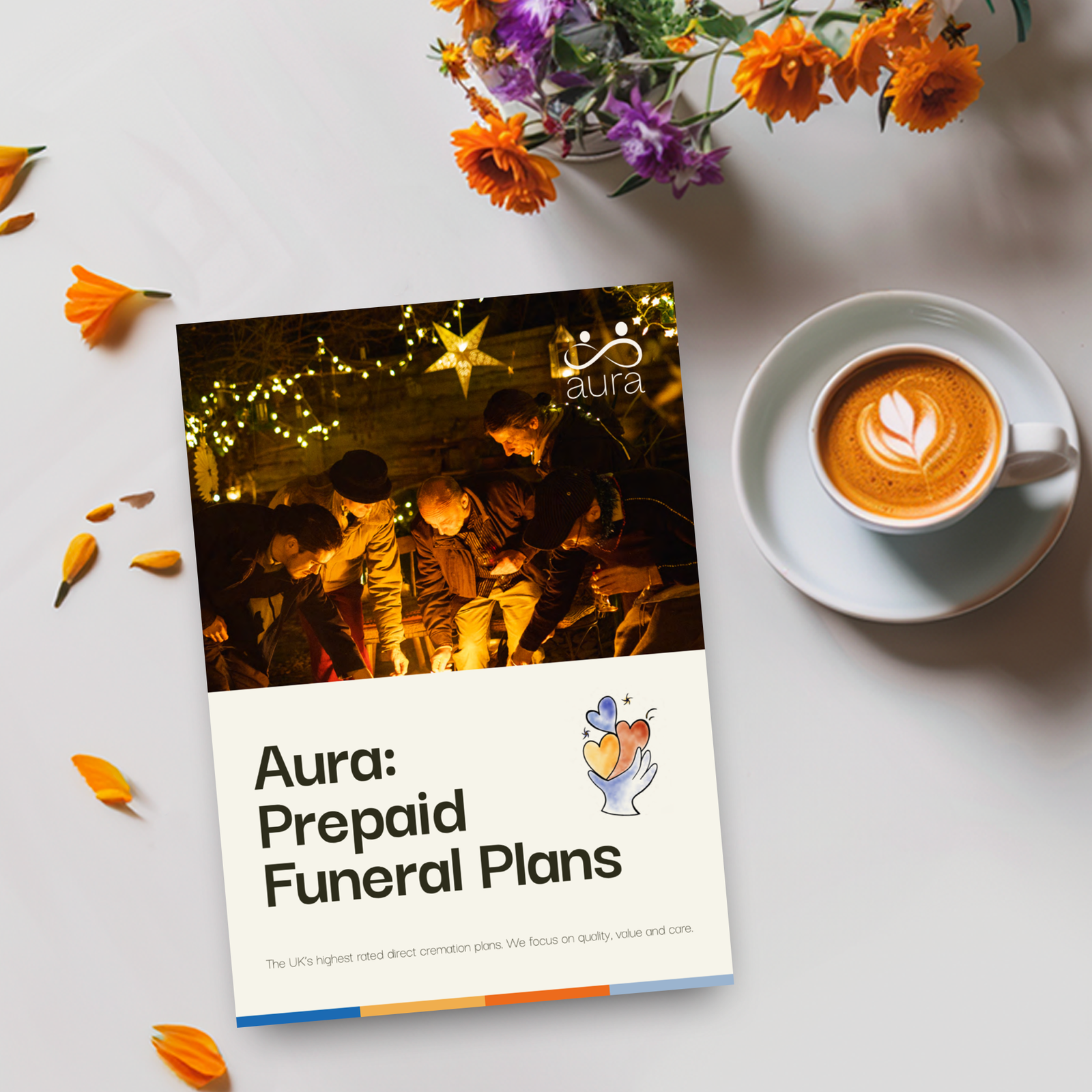
If you’d like to know more about how to plan a cremation with Aura, our brochure is a helpful place to begin.
Our funeral plans are a helpful way to put everything in place for you or someone else.
When the time comes, our experienced team will be here to guide you through each step, offering support and advice whenever you need it.
To find out more about how our plans work, what’s included, and our story, you can request a brochure by clicking the link below. We will then send you a copy by email or First Class post—whichever you prefer.
Poems help express emotions that are often hard to put into words during grief. They offer comfort, celebrate a life, and create a sense of peace or connection—whether read aloud, printed in an order of service, or shared privately.
Consider the personality of the person who has died, the tone you want to set (e.g. comforting, uplifting, spiritual), and the type of service. Traditional, religious, modern, or even personalised poems can all be fitting, depending on your loved one’s wishes or legacy.
Popular poems to read at a funeral include “Do Not Stand at My Grave and Weep” by Mary Elizabeth Frye, “Remember” by Christina Rossetti and “Death Is Nothing at All” by Henry Scott-Holland. The best choice is one that reflects the personality, beliefs and relationship you shared with the person who died.
Absolutely. Writing your own poem or personalising an existing one can create a deeply meaningful tribute. Even a few heartfelt lines that reflect your relationship, memories, or shared experiences can be incredibly powerful.
Yes. Poetry is often used in intimate or direct cremation ceremonies, at ash scatterings, or in quiet, private reflections. It can help create a moment of connection and meaning even without a formal service.
Poems can be printed in orders of service, memorial cards, photo tributes, or included on digital memorial pages. These allow mourners to carry comforting words with them and reflect on them after the ceremony.
There is no single definitive grief poem, but “Do Not Stand at My Grave and Weep” by Mary Elizabeth Frye is among the most famous. Other well-known poems about grief include Christina Rossetti’s “Remember”, W. H. Auden’s “Funeral Blues” and Henry Scott-Holland’s “Death Is Nothing at All”.
At Diana, Princess of Wales’s funeral in 1997, her sister Lady Sarah McCorquodale read “Turn Again to Life” by Mary Lee Hall. The poem encourages those grieving to continue living fully while remembering the person who has died, which reflected the themes of grief and remembrance at the service.