×

Plan ahead and save up to £200 Save up to £200 on selected funeral plans until 31 October. T&Cs apply. Click here for full details.

Two Together: Save £100!Save £100 when you purchase two funeral plans together. Call us for more details.


Written by Adam McIlroy.
17 minute read

Article reviewed by Steven Barratt, Founder of Save Funeral Costs on August 14, 2025.
Funerals can be expensive, and for many families, the cost can come as a shock. If you’re facing the loss of someone close to you and worrying about how to pay for a funeral with no money, you’re not alone. It’s a situation more people find themselves in than you might expect.
At a time when emotions are already high, financial pressure can feel overwhelming. You may be asking questions like what happens if you can’t afford a funeral in the UK, or who is responsible for paying funeral costs.
In this guide, we gently explain your options. From government support and charities to using the estate or choosing simpler alternatives, there are ways to manage funeral costs, even if money is tight. We’d also like to acknowledge that this may be a difficult time for you. At Aura, we’re here to support you with care, clarity, and compassion whenever you need it.
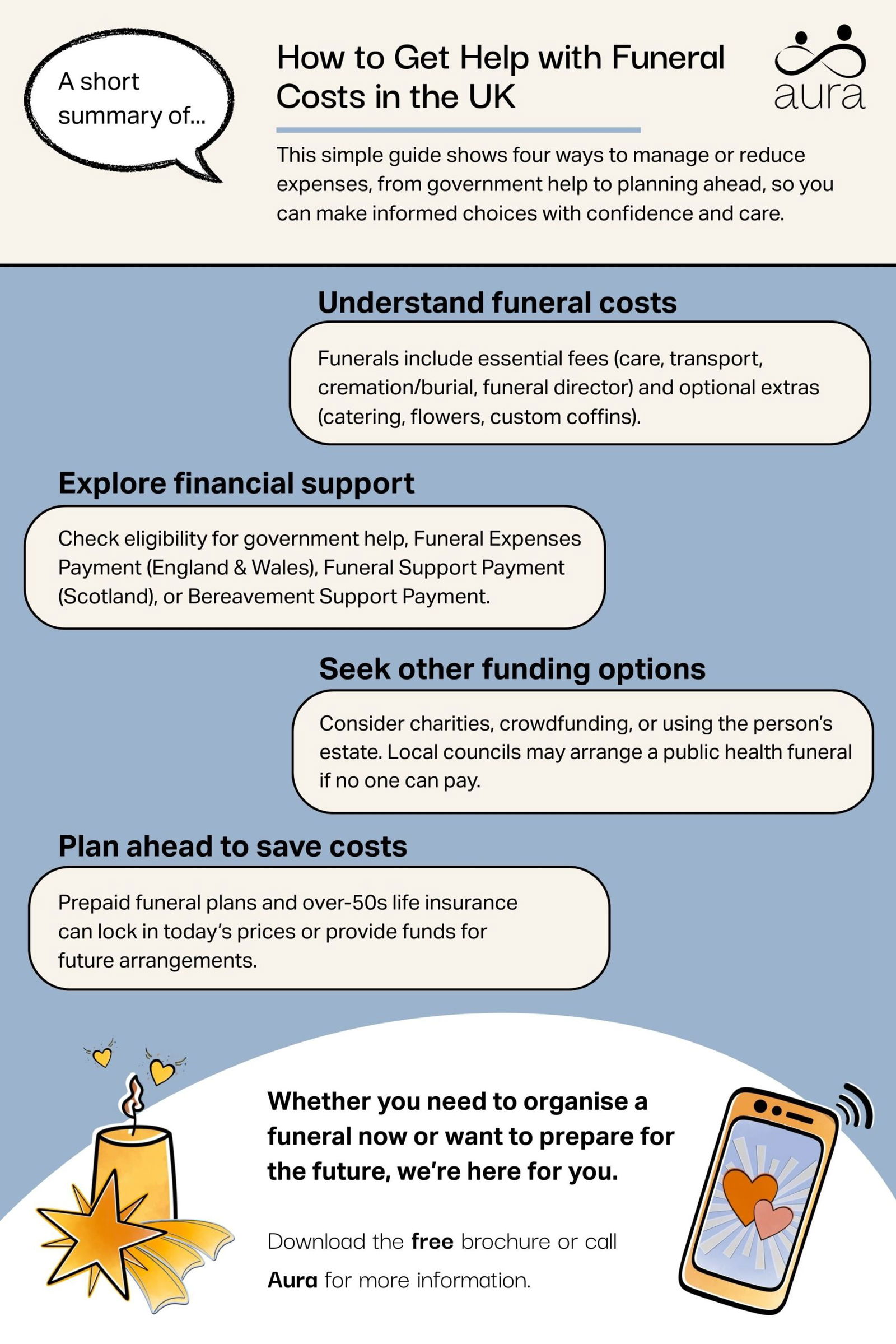
There are a lot of different elements that make up the final price you’ll pay for your funeral, which is why it can sometimes be difficult to work out how much a funeral costs. There are different types of funeral expenses, and various reasons why financial assistance could be needed.
In general, a funeral has certain key expenses that can’t be avoided, and others which cover additional extras that the family can organise on top of the necessities should they see fit. Something like a direct cremation, as provided by Aura, offers people a low-cost, modern alternative to the traditional funeral. It’s a simple, yet dignified approach to funerals which focuses on the cremation process, rather than the typical ceremonial elements of a bigger funeral.
With a funeral, examples of essential costs can include:
Additional extras would concern things like the cost of catering for a wake, or any kind of customisation to elements like the burial urn or casket. It’s important to ensure you understand what your direct cremation includes before purchase.
Many people aren’t aware of quite how expensive organising a funeral can be, and as such, they may not budget appropriately or start any kind of funeral checklist beforehand. Naturally, the cost of living crisis has had an enormous impact on our collective spending power, as well as increasing the cost of everything, including the cost of dying, in recent years. Indeed, SunLife puts the national average total cost of a funeral in the UK at £5,140. It’s hardly any wonder that, as pointed out by Legal & General, we have seen a 23% increase between 2018 and 2023 in instances of a public heath funeral, sometimes referred to as a ‘Pauper’s Funeral’ across the country.
With costs at this level, This leads many people to ask, ‘What happens if you have no money for a funeral?’ and ‘Who pays for funeral costs in the UK?’. The answer is that there are several possible routes for support, which we’ll explain below.
It may be possible to receive support from the government, which can allow those who are eligible to claim funeral costs back.
When someone dies, people can turn to the government to help them bear the cost of the funeral. One of the ways people can do that is through the Funeral Expenses Payment in England and Wales, or the Funeral Support Payment in Scotland.
The FEP is available to:
To qualify, you must also be claiming certain benefits like Universal Credit, Income Support, Pension Credit, or similar. It’s important that no one else who is closer in the family line is willing or able to pay for the funeral.
This eligibility rule highlights that being next of kin doesn’t automatically mean you must foot the bill – does next of kin have to pay for funeral costs is a question our guide answers, outlining legal responsibilities and support available.
Families also often want to know more broadly who is responsible for funeral costs. In many cases, this can be covered through the estate of the person who has died, government payments, or prepaid plans. Sometimes, family members contribute, but support is available so the responsibility does not fall on one person alone.
If the funeral expenses have not yet been paid, merely organised, then the government will make a payment directly to the appointed funeral director on behalf of the bereaved party or to the bereaved party themselves. If on the other hand, funeral or cremation costs have already been paid, then a reimbursement payment will be issued to successful applicants. In the case of the latter, it’s very important to keep hold of receipts and invoices so that you can give proof of payment when asked.
In order to apply, families will need to provide documentation that proves they are already claiming benefits (or have applied to claim benefits); proof of their agreement to proceed with a funeral director, or of funeral expenses having already been paid; and, possibly, proof of the death of the person who has died, such as via a Death Certificate.
The FSP is available to people living in Scotland who are on certain low-income benefits and need help covering the costs of a funeral they’re responsible for. You may qualify if:
Only one person can receive the payment, and it’s usually given to the person who has the closest relationship to the person who has died. If more than one person applies, Social Security Scotland will decide who is most entitled based on their relationship to the person who has died.
How far the Funeral Support Payment or Funeral Expenses payment will stretch depends on the type of funeral being arranged —while it may not always cover all the costs associated with a more traditional funeral, it could be enough to pay for a direct cremation or DIY funeral in full.
The government can offer support via another scheme called the Bereavement Support Payment, which is a different application process to the Funeral Expenses Payment and the Funeral Support Payment. The Bereavement Support Payment is financial support for surviving spouses or civil partners, regardless of funeral costs, and you don’t need to be on benefits to qualify.
There could also be support available from your local council. Devolved governments across the UK have capacity to offer their own forms of the Funeral Expenses or Bereavement Support Payments, particularly if the person who died has no one to arrange the funeral or no funds to pay for it, and requires a public health funeral.
Beyond different forms of government support, families looking for help with funeral or direct cremation prices can turn to third-parties, or not-for-profit organisations for support.
There are charities out there that can signpost you towards useful resources, and possibly pay some or all of the cost of a funeral. The Quaker Social Action charity can help you to identify funding opportunities that could support you through funeral-related financial difficulty, whether through the government or employer-specific or industry-specific charities. Some additional charities include Turn2us and Stepchange.
Finding help with funeral costs can feel overwhelming, especially when you’re coping with the early days of grief and trying to make decisions. Alongside financial support charities, there are also emotional support charities that can help you to navigate that grief amongst everything else going on. For instance, Sue Ryder offers guidance on things like joining local death cafes, which many people find to be a great way of learning how to talk about death and dying with others who are grieving near them.
Where charity or government support is not available or appropriate for some people, some may find it productive to set up crowdfunding initiatives to help them fund a funeral. Crowdfunding websites like GoFundMe and JustGiving allow you to post a funding request, where you can add details of the life-story of the person who has died, as well as details of their proposed funeral. You can then share the request on social media, for instance when you are announcing a death to friends.

Many people intend for their families to use their estate to pay for the cost of their funeral. However, this can often be more complicated than it seems.
While it’s often the next of kin who steps in to pay for a funeral upfront, it’s not always the case – sometimes, the funeral can be paid for from the estate of the person who has died, offering another option for how to pay for funeral expenses. However, using the estate to cover costs isn’t immediate, and it does involve a few administrative steps.
You’ll need to register the death first in order to obtain a death certificate. This document is essential for most processes that follow, including claiming on life insurance policies such as an over-50’s life insurance policy, or accessing funds from the estate. It’s also a requirement when applying for probate, the legal authority to manage someone’s estate.
If the person left a will, this should name an executor, who is responsible for dealing with the estate. When someone dies without a will, you can still apply to distribute their estate, but rather than probate, you will apply for something called a “grant of letters of administration”. Both processes can take time, which is why families sometimes pay funeral costs first and then claim them back from the estate later.
It’s also worth bearing in mind that if you’re applying for government help with funeral costs, they’ll first look at whether the estate has any funds available to cover some or all of the funeral expenses. If it does, this could affect how much help you receive.
When there is no estate left by the person who has died, then government support may be available in the form of the Funeral Expenses Payment or the Bereavement Support Payment. If there is nobody willing and able to fund and organise the funeral, the local government, as a last resort, is legally obliged to step in and provide a public health funeral for anyone who has died within its jurisdiction.
There are other ways of paying for funeral costs available, from prepaid funeral plans to loans or payment plans.
If you are unsure of what a funeral plan is, a good way to understand it is to think of it as an agreement between you and a funeral provider. In effect, once you have paid them and specified what kind of funeral you want, they will keep your money aside until the day it is needed, at which point they will use it to pay for your funeral.
If you buy an Aura funeral plan, we will put your money aside in our FSCS-protected, independently managed trust, where it will be safe from the potential impact of inflation and rising funeral costs. You will lock in today’s prices, guaranteeing that your family won’t have a penny extra to pay when the time comes.
Over-50’s life insurance is a form of insurance covering funeral costs, and is another way that people go about providing for their own funeral further down the line. It works through paying premiums every month (which are usually at a fixed level and generally cannot increase once they start to be paid) until you die, at which point the policy can pay out a lump-sum in cash to the family.
Some people choose to take out an over-50s life insurance policy to help cover the cost of their funeral. These plans usually involve paying a fixed monthly premium for life, in exchange for a guaranteed payout when you die. However, it’s worth noting that depending on how long you live, you could end up paying more into the policy than it eventually pays out. It’s also important to read the small print carefully, as some policies have waiting periods or exclusions that could affect the payout.
There are a number of steps you will need to go through in order to apply for financial assistance with funeral expenses from the government in England and Wales.
In Scotland, the process is a little different. The Scottish scheme tends to be more flexible — it allows you to apply before the funeral has taken place, whereas in England and Wales you must wait until you have a final invoice. Scotland also offers a slightly higher allowance for other funeral expenses (up to £1,257.75, compared to £1,000 in England and Wales). Additionally, the Scottish system places less emphasis on whether you’re the closest relative, allowing more flexibility over who can claim, depending on their relationship to the person who has died and financial responsibility. Application processes and contact points also differ, with Scotland operating its own dedicated service, separate from the DWP.
We hope that this article has helped you feel more familiar with how to get help with funeral expenses. If you need to organise a funeral for a loved one in the here and now, we want you to feel as comfortable and as well informed as can be.
If you’d like Aura’s help with arranging a low cost cremation, whether today or as part of a prepaid funeral plan for the future, our Angel team is always ready to take your call. We are the UK’s top-rated ‘Cremation Services’ provider on Trustpilot with 4.9/5 stars. It’s the compassionate and informed approach of our Angels which is central to this recognition.
We are also proud of the fact that we are a family-run company. We were set up by Paul Jameson in 2019, following his confrontation with motor neurone disease and his own mortality. He wanted to pass on the benefits of what he’s learned to everyone in the UK struggling with end-of-life planning, and he still runs the company today alongside his son, Dave (our CEO), and Ben (our COO), a family friend. Every day, we strive to offer nothing less than the service Paul would want for his own family, to everyone in our care.
If you’d like our support with funeral arrangements, or with the paperwork that funeral arranging can generate, please feel free to give us a call. We’re here to help.


If there are no funds available, you may be able to access government support, use the estate, or seek help from charities. If no one can pay, the local council will arrange a public health funeral.
Yes. You may be eligible for support through:
Funeral Expenses Payment (England & Wales)
Funeral Support Payment (Scotland)
Bereavement Support Payment (UK-wide for spouses/civil partners)
These schemes offer partial or full coverage of essential funeral costs if you receive certain benefits.
You may qualify if you’re:
The of the person who has died, close relative, or friend
Responsible for the funeral
On certain income-related benefits (e.g. Universal Credit, Income Support)
Eligibility criteria vary slightly between England/Wales and Scotland.
Yes. If you’re eligible, you may be reimbursed for costs already paid. Make sure to keep receipts and invoices as proof of payment.
You can seek support from:
In some cases, yes.
If the person who has died had money in their bank account, the bank may release funds directly to pay funeral costs. This is usually paid straight to the funeral director, rather than to a family member.
You will typically need:
This can be an important option when considering how to pay for a funeral with no money upfront.
Consider a prepaid funeral plan to lock in today’s prices, or over-50s life insurance. These can reduce the financial pressure on loved ones later.