×

Plan ahead and save up to £200 Save up to £200 on selected funeral plans until 31 October. T&Cs apply. Click here for full details.

Two Together: Save £100!Save £100 when you purchase two funeral plans together. Call us for more details.

Written by Emily Cross.
20 minute read

Article reviewed by Paul Jameson, Co-Founder of Aura on May 30, 2025.
To plan your own funeral, think about whether you’d prefer burial or cremation, the type of service you’d like and your budget. You can also choose music, readings and personal touches. Write down your wishes and share them with someone you trust. A prepaid funeral plan can help cover the costs.
Planning your own funeral may feel difficult, but it can bring peace of mind knowing your wishes are clear and your family has some guidance when the time comes. Whether you’d like to follow British funeral traditions or do things differently, you can create a farewell that reflects your personality and values. You don’t need to decide everything at once.
In this guide, we’ll walk you through the choices involved, how to record your wishes and what to expect from the funeral process, so you can plan at your own pace.
Key takeaways:
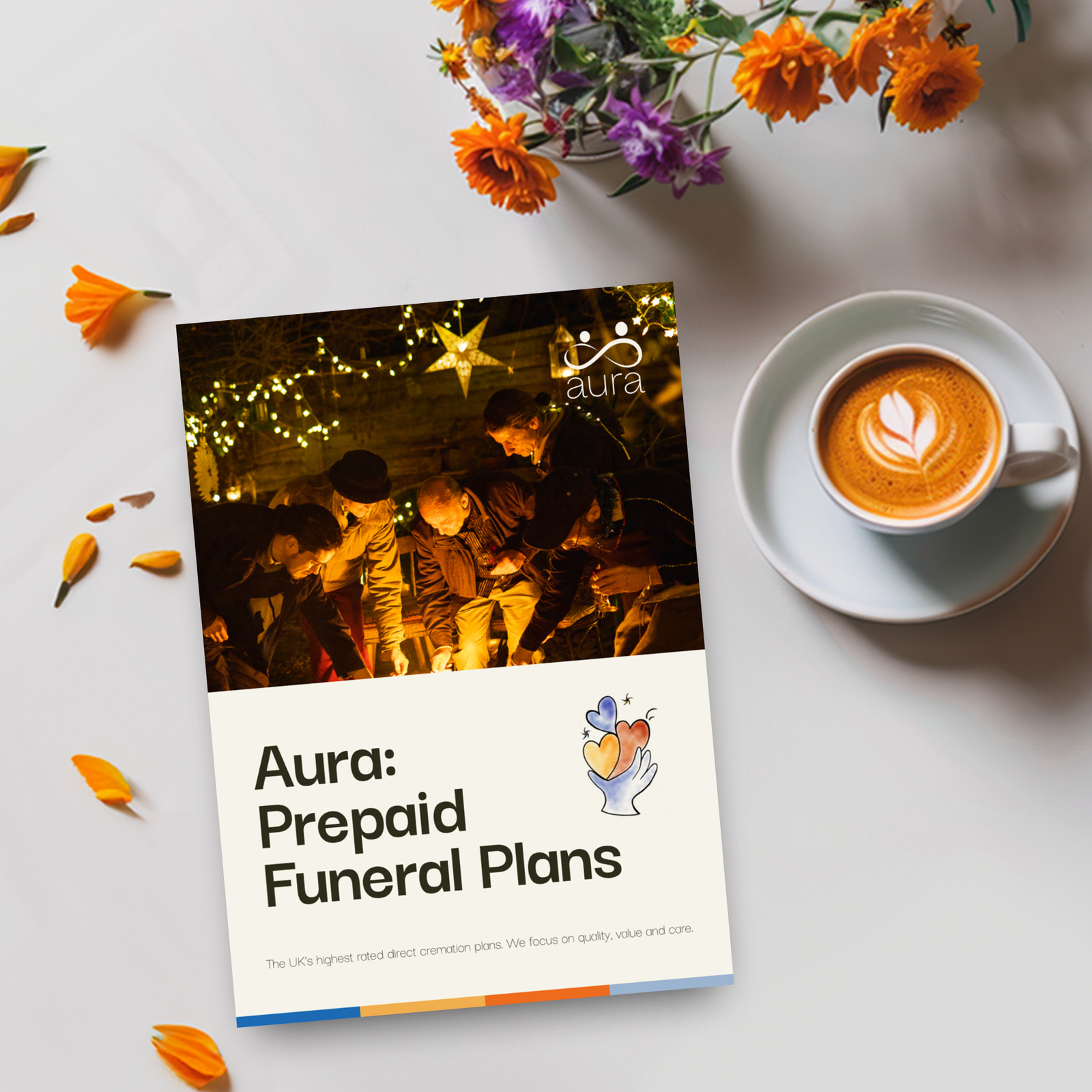
If you’d like to know more about how to plan a cremation with Aura, our brochure is a helpful place to begin.
Our funeral plans are a helpful way to put everything in place for you or someone else.
When the time comes, our experienced team will be here to guide you through each step, offering support and advice whenever you need it.
To find out more about how our plans work, what’s included, and our story, you can request a brochure by clicking the link below. We will then send you a copy by email or First Class post—whichever you prefer.
If having a say in what happens at your funeral is important to you, mapping out your own details can bring great peace of mind to you and those around you, removing any question marks from the future.
Choosing your own funeral particulars allows you to craft a goodbye that feels very authentically ‘you.’ From the type of service to the music played, each element can be tailored to reflect your identity, style, values, and beliefs. This level of personalisation ensures that your vision is not only carried out but celebrated, creating a unique event that feels true to your life. This is especially true for any end-of-life celebration you’d like to be held for you, or any cremation ashes ideas you might have regarding scatter-places, or keepsakes.
Getting clear on your preferences also offers a sense of reassurance, both for you and for your loved ones. Preplanning eliminates uncertainty, giving your family a transparent blueprint of your wishes. It will help them find comfort during a difficult time, and there will be no question as to what you would have wanted.
Advanced preparation provides your family with clarity, and can help to spare them from difficult decisions whilst they are grieving.
The grieving process can introduce a whole host of confusing emotions and thoughts, whether for the unexpected death of a loved one or anyone else. By planning ahead, you will have given those you leave behind a great gift by removing any worries or concerns they may have had over your wishes. This can also help ease anxiety around the waiting time for a funeral, as many decisions are already settled.
They’ll have a sense of direction knowing exactly what you wanted, which can be invaluable at what can already be a very difficult time. Financially, prearrangements can also ease worry by covering or securing funds for funeral expenses, removing an extra layer of pressure from loved ones.
One of the first decisions to make is whether you’d prefer to be buried or cremated. This may come down to your personal beliefs, family traditions, budget or simply what feels right to you.
Burial usually involves being laid to rest in a cemetery or burial ground. You might prefer a traditional burial, a natural burial in a woodland setting or a particular location that holds meaning for you.
Cremation offers different options for a farewell, including a service attended by family and friends or a simpler, unattended cremation. Your ashes can then be kept, buried or scattered, depending on your wishes and any local requirements.
Both choices can be personal and meaningful. If you’re undecided, it may help to compare the costs and practical differences between cremation and burial before making a decision. You can also write down any preferences about where you’d like to be buried or cremated, so your family knows what matters to you.
Once you’ve decided between burial and cremation, think about the kind of farewell you’d like. There are several types of funerals, and you don’t have to follow a traditional format if it doesn’t feel right for you. Some options include:
These options aren’t always mutually exclusive. For example, you could choose a non-religious cremation service or arrange a celebration of life following a direct cremation. Think about whether you’d like people to gather, where you’d feel comfortable having the farewell and how formal or informal you’d like it to be.
If you’d like a funeral service, you can make it as traditional or personal as you wish. Even a few small details can help your family create a farewell that reflects who you are. Here are some things you might like to think about:
You can also think about who you’d like to lead the ceremony, whether that’s a religious leader, a civil celebrant or someone you know. If you’d like particular people to take part, consider speaking to them beforehand. That way, they’ll know what you’d prefer and can decide whether they feel comfortable with the role.
You don’t need to plan every detail. Even a few favourite songs or a general idea of the atmosphere you’d like can give your family something meaningful to work with.

Your plans don’t have to end with the funeral itself. You might also have wishes about what happens to your ashes, how you’d like to be remembered or whether family and friends gather afterwards.
If you choose cremation, think about what you’d like to happen to your ashes. You could ask for them to be scattered somewhere meaningful, buried in a cemetery or kept by someone close to you. There are also more personal ways to remember someone through their ashes.
For a lasting memorial, you might prefer a plaque, a tree planted in your memory or a special place where loved ones can visit. You can share ideas without feeling you need to make every decision yourself. For the wake or gathering, consider whether you’d like people to come together after the funeral. This could be a traditional wake, a meal at a favourite restaurant or a relaxed gathering at home. You might also prefer a separate memorial service at a later date, giving family and friends more time to come together.
Whatever you decide, recording a few preferences can help your loved ones arrange something that feels true to you.
Thinking about funeral costs now can help you choose arrangements that suit your budget and give your family a clearer idea of what to expect. The amount you’ll need depends on whether you choose burial or cremation, the type of service and any extras you’d like to include.
According to the SunLife Cost of Dying Report 2026, the average costs are:
| Type of funeral | Average UK cost |
|---|---|
| Direct cremation | £1,628 |
| Simple attended funeral | £3,828 |
| Simple attended burial | £4,758 |
| Traditional attended cremation | £4,200 |
| Traditional attended burial | £5,440 |
*These figures are national averages, so actual prices will depend on your location and provider.*
SunLife also found that families spent an average of £1,312 on additional send-off costs, such as flowers, catering and memorials. Combining this with the average simple attended funeral brings the total to £5,140.
When setting your budget, consider any extras you’d like your family to arrange. You might want a particular coffin, a memorial, flowers or a gathering afterwards. It’s worth asking funeral providers for a written breakdown of what’s included. You can also explore ways to arrange a low-cost funeral without giving up the personal touches that matter to you.
Once you’ve thought about the arrangements you’d like, it’s important to write them down. This gives your family something to refer to when the time comes, rather than leaving them to guess what you would have wanted. There are several ways to record your preferences, and you can use more than one.
| Option | What it does | What to remember |
|---|---|---|
| Funeral wishes form | Records your preferences for burial or cremation, the service and personal details | Usually not legally binding, but provides useful guidance |
| Will | Sets out how your estate should be handled and names your executors | Funeral wishes in a will are generally not legally binding, and the will may not be read before the funeral |
| Prepaid funeral plan | Records arrangements and pays for specified funeral services in advance | Check exactly what’s covered, any exclusions and how changes are handled |
If you’re writing a will, you can mention your funeral preferences there. However, it’s sensible to keep a separate, easily accessible copy so your family can find it when needed.
Share your plans with someone you trust, such as your partner, a close family member, a friend or the executor of your will.
Make sure they know:
It’s also worth having a conversation about your preferences rather than relying on written instructions alone. Talking about death and dying isn’t always easy, but it can help your loved ones understand your choices. Remember that you can review and update your wishes whenever your circumstances or preferences change.
Paying for your funeral ahead of time is optional, but you may want to make some financial arrangements so your family has fewer costs to manage later.
There are three common approaches, each with its own benefits and limitations.
A prepaid funeral plan lets you arrange and pay for specified funeral services in advance, either through a single payment or an agreed payment schedule. This can give your family a clearer idea of what’s already arranged and covered. However, plans differ, so it’s important to check what’s included, what might cost extra and whether you can make changes later.
In the UK, providers selling regulated funeral plans must be authorised by the Financial Conduct Authority (FCA), or operate as an appointed representative of an authorised firm.
Life insurance, including over-50s policies, can provide a cash payout to your beneficiaries when you die. Your family could use this money towards funeral costs, although the payout may not cover the full amount. Depending on the policy, premiums, waiting periods and exclusions may apply. With some policies, you could also pay more in premiums than the eventual payout.
You can read more about the differences between funeral plans and over-50s life insurance.
You may prefer to put money aside in a savings account specifically for your funeral. This gives you flexibility over how much you save and how the money is used. However, funeral costs may rise over time, and your family could face delays or restrictions when accessing the funds after your death.
Whichever option you choose, make sure someone you trust knows about it and where to find the details. There’s no single approach that suits everyone. The important thing is to choose something that works for your circumstances and helps your family understand what arrangements you’ve made.
Choosing the right funeral service provider is essential to achieving the desired outcome for your funeral plans. Look for providers who align with your budget, values, and ideal level of support. You may also want to consider a provider’s reputation and experience; reading reviews or speaking with others who have used their services can provide valuable insights. Especially when putting your money into preplanning with a company, it’s important to do your research and compare funeral plans to make sure your funds are well protected.
If you’re looking to alleviate some worry for your loved ones after your death, you might be interested in purchasing a prepaid funeral plan. Arranging a funeral after experiencing a loss can feel overwhelming; by considering a prepaid funeral plan from Aura as part of your end-of-life preparations, you are taking steps towards creating a more peaceful and secure future for your family. Aura’s plans allow you to arrange the details and cover the costs of your funeral in advance, making sure that your family is taken care of during what can be an emotional and distressing time.
As a family-owned and operated funeral provider, our strong ethos, tight-knit team and compassionate values colour everything we do. Our founder Paul Jameson was inspired by his own journey with end-of-life planning in 2019 after his Motor Neurone Disease diagnosis. He wanted to establish a company that helps families in the UK to benefit from his own experience with planning a funeral and end-of-life planning. Today, Paul continues to lead Aura alongside his son, David (our CEO), and a family friend called Ben (our COO). Our mission is to provide a service quality that never drops below what Paul would want for his own family. We’re also the UK’s top-rated provider of ‘cremation services’ on Trustpilot, with a score of 4.9/5 stars.
A prepaid funeral plan empowers you to arrange your funeral according to your preferences, ensuring your wishes are respected and carried out. When the time comes, our team of expert funeral arrangers, the Aura Angels, will be there to guide your family through every aspect of the arrangement. Whether it’s handling paperwork or offering emotional support, we’ll be there to help as much or as little as needed.
Not only will purchasing a prepaid plan help you to feel more prepared, by securing today’s prices, you protect your family from rising funeral costs in the future. You might be asking yourself, “Are funeral plans safe?”: Aura is regulated by the Financial Conduct Authority (FCA), and our plans are protected by the Financial Services Compensation Scheme (FSCS). So, you can rest assured that, when you purchase a prepaid funeral plan from Aura, your money is secure.

A living funeral is a gathering held while you’re still alive, giving you the chance to celebrate your life with family and friends. It’s an opportunity to share memories, express appreciation and enjoy meaningful time together.
There’s no set way to organise one. You might prefer a relaxed meal at home, a gathering in your favourite place or a celebration with music, photographs and personal stories. You can make it as simple or as special as you like.
For people living with a serious or life-limiting illness, a living funeral can offer a chance to say goodbye on their own terms. But anyone can choose to have one, and there’s no pressure to make it a formal occasion. If the idea appeals to you, our living funeral ideas can help you plan a gathering that feels right for you.
Aura is here to work alongside and support you, should you choose to plan your own funeral. We are proud of the compassion, patience and kindness with which we offer our expertise. Our wonderful Aura Angels will be there to guide you and your family by the hand when considering a prepaid funeral plan. They’re not only funeral-arranging experts, but they offer a compassionate and personalised service that is second to none..
As a family-run company, we are committed to providing you with the kind of care and respect we would offer our own families. Our plans provide an affordable alternative to traditional funerals, offering peace of mind for you and those closest to you. For more information, please feel free to get in touch with our team.


If you have any questions, would like a brochure or simply would like a chat through our services, our award-winning team is here to help.
Unlike other providers, we won’t hassle you with constant calls. We’ll simply ensure you have the information you need and leave you to come to a decision in your own time. When you’re ready for us, our team will be ready to help.
Our team is available Monday–Friday, 9.00–5.00pm.
Yes, you can. Planning your own funeral lets you make choices that reflect your wishes and helps ease the burden on your family.
You’ll need to decide on burial or cremation, the type of service, and how to cover the costs. Many people choose a prepaid funeral plan to fix today’s prices and avoid rising costs.
Be sure to document your wishes and share them with someone you trust, so they’re known and respected when the time comes.
Planning your own funeral allows you to express your personal wishes, reduce emotional and financial stress for your family, and make arrangements that reflect your values and personality. It also ensures your funeral is carried out the way you want, with clarity and no uncertainty left for loved ones.
A prepaid funeral plan allows you to arrange and pay for your funeral in advance. A will outlines how your assets should be distributed. While a will can include funeral wishes, these aren’t legally binding and may be read too late. A prepaid plan ensures everything is in place and financially covered ahead of time.
It’s becoming increasingly common, especially among those aged 60–80 who want to ease the burden on their family. Many people find peace of mind knowing their wishes are written down and paid for ahead of time.
Costs vary depending on the type of service. Aura offers prepaid direct cremation plans from as little as half the price of a traditional funeral, with no hidden fees. Attended cremation, coffin types, transport and memorial extras may add to the cost.
Yes. From your choice of music, readings, and flowers to coffin materials, clothing, or even creative send-offs like fireworks or keepsakes, you can customise your funeral exactly how you’d like it. Aura encourages personal touches that reflect your life and wishes.
A living funeral is a gathering held before death to celebrate your life with those you love. It’s a chance to share memories and say goodbye in person. It can be formal or informal, traditional or light-hearted — the choice is yours.
Yes. Your funeral plan can be updated if your preferences change. With Aura’s services, you can amend your plan or update your wishes at any time.
Martin Lewis doesn’t recommend a specific provider but says prepaid funeral plans can be worthwhile if you pay upfront or over 12 months interest-free. He advises caution with long-term plans that charge high interest or risk you paying more than the funeral’s worth.
Look for a plan from an FCA-regulated provider, check what’s included, and avoid anything that could leave your family under pressure or out of pocket.
Write them down, share them with trusted family or your nominated representative, and consider storing them securely…either with your will, a funeral provider, or in a digital tool like Aura Circle, which makes it easy to update and share plans.
You should register your wishes formally and inform your family. Organ donation in the UK is opt-out, but confirming your choice can help prevent confusion. Body donation must be arranged with an approved institution ahead of time.
Yes, if they are properly regulated. Aura’s plans are authorised by the Financial Conduct Authority (FCA) and protected by the Financial Services Compensation Scheme (FSCS) — your money is safe and secure.
It’s a good idea to have a backup funeral plan just in case. Not all bodies are eligible for donation due to medical or timing reasons. A prepaid funeral plan ensures an alternative is in place.
Look for a provider with strong customer reviews, transparent pricing, regulated plans, and a team that offers support with empathy. Aura is rated 4.9/5 on Trustpilot and is the UK’s only provider with two five-star-rated funeral plans from Fairer Finance.