×

Plan ahead and save up to £200 Save up to £200 on selected funeral plans until 31 October. T&Cs apply. Click here for full details.

Two Together: Save £100!Save £100 when you purchase two funeral plans together. Call us for more details.


Written by Adam McIlroy.
16 minute read

A memorial service is a gathering to remember and celebrate the life of someone who has died. Usually held after a burial or cremation, without the body present, it can take place anywhere, at any time. Also known as a remembrance or commemoration service, it can be as formal or relaxed as the family wishes.
Unlike a traditional funeral, a memorial service gives families more flexibility over how and when they come together to remember someone they love. This can make it a meaningful way to say goodbye, with the freedom to include personal touches that reflect the person’s life and wishes.
If you’re considering arranging a memorial service, you may be wondering where to hold it, what to include and how it differs from a funeral. In this guide, we’ll explore these questions and share some thoughtful funeral and memorial ideas to help you plan a fitting tribute.
Whether you’re remembering someone close to you or planning ahead for yourself, we understand that these decisions can feel difficult. We hope this guide offers some clarity and reassurance as you consider what feels right for you and your family.
Key takeaways:

While memorial services and funerals share many similarities, there are some important differences. At a traditional funeral, the person who has died is usually present in their coffin before their burial or cremation. A memorial, however, focuses on bringing people together to remember them, often after these arrangements have taken place.
Rather than having a coffin present, families may choose to display photographs, play favourite songs or include an urn containing their loved one’s ashes. Some families prefer an end-of-life celebration, where sharing stories and happy memories helps create a personal tribute.
Another key difference is that what happens at a funeral usually includes the burial or cremation process, whereas these arrangements have often already taken place before a memorial service. This means families can focus on remembering their loved one without having to plan everything around the burial or cremation.
For some, holding a memorial a little later provides time to come to terms with their loss and think about how they’d like to remember the person who has died. Others may prefer to gather sooner. There’s no right or wrong choice, and a memorial can simply be one part of your wider plans, alongside the arrangements covered in our funeral arrangements checklist.
Funerals and memorial services both give family and friends an opportunity to come together, remember someone they love and say goodbye. The main differences are when and where they take place, whether the body is present and how the gathering is arranged.
| Funeral | Memorial service | |
|---|---|---|
| Timing | Usually held within days or weeks of a death, depending on personal circumstances and religious beliefs. | Can take place at any time, including weeks, months or years later. |
| Body present | The person who has died is usually present in a coffin or other suitable covering. | The body is not usually present, although an urn containing their ashes may be included. |
| Location | Often held at a crematorium, place of worship or burial ground. | Can take place almost anywhere, from a community hall or garden to a favourite outdoor location. |
| Who leads it | Often led by a religious leader, celebrant or another chosen person. | Can be led by a celebrant, family member, friend or anyone the family chooses. |
| Tone | May be traditional, reflective or celebratory, depending on the person’s wishes and beliefs. | Often more flexible and personal, with a focus on sharing memories and remembering a loved one. |
| Cost | Usually includes burial or cremation costs, alongside any ceremony and funeral director’s fees. | Costs vary depending on the venue, catering and other arrangements. A simple gathering can be inexpensive, although burial or cremation costs still need to be covered separately. |
A wake is usually an informal gathering around the time of a funeral, often afterwards, while a memorial service is a separate occasion that can be held much later.
Every memorial service is different, and there’s no set order you need to follow. Some families prefer a traditional ceremony, while others choose a relaxed gathering where everyone can share memories. Whatever feels right, here’s an example of how a memorial service might unfold.
A memorial service usually lasts between 30 minutes and two hours, depending on the number of readings, tributes and activities included. More informal gatherings may last longer, especially if family and friends choose to spend time together afterwards.
There’s no need to follow a strict schedule. What matters most is allowing enough time to remember your loved one in a way that feels comfortable and meaningful.
There are many ways to hold a memorial service, and the right choice will depend on your loved one’s wishes, beliefs and personality. Some families prefer a traditional ceremony, while others choose something more informal and personal.
Here are some of the different types of memorial service you might consider:
There’s no single way to remember someone you love. You can also combine elements from different types of memorial services to create a gathering that feels right for your family.

Planning a memorial service is an opportunity to bring family and friends together in a way that reflects your loved one’s life. Taking things one step at a time can make the arrangements feel more manageable.
A memorial service can take place weeks or months after someone has died, giving everyone time to prepare. Choose a date that works for close family and friends, or consider a meaningful occasion, such as a birthday or anniversary.
Choose somewhere that reflects your loved one’s personality, whether that’s a community hall, place of worship, favourite restaurant or peaceful outdoor setting.
Consider accessibility, guest numbers and the weather. The setting may also influence what to wear to a memorial service, so it’s helpful to let guests know what to expect.
A family member, friend or professional funeral celebrant can lead the gathering.
A celebrant can help organise the running order, introduce speakers and guide the ceremony, although there’s no need to have one if you’d prefer something informal.
Favourite songs, poems, photographs and shared memories can help make the service personal.
You might include meaningful stories about death, explore the best funeral songs or choose from fun and uplifting funeral songs.
You could also invite guests to share memories or include a tribute to a hobby, interest or charity that mattered to your loved one.
Once you’ve confirmed the arrangements, let family and friends know the date, time and location. Invitations can be sent by post, email or message.
Include any useful details about parking, accessibility, refreshments or dress code, along with whether guests are welcome to share a reading or memory.
Remember, a memorial service doesn’t need to be elaborate. What matters most is creating a meaningful opportunity to remember someone together.
A direct cremation is a simple, unattended cremation without a funeral service beforehand. It allows families to say goodbye in their own way, without having to organise a ceremony at the same time as the cremation.
For some families, this means having more time to plan a personal memorial when they feel ready. You might choose to gather a few weeks or months later, somewhere meaningful to your loved one, with music, photographs and shared memories.
There’s no set way to arrange a memorial after a direct cremation. It could be a quiet gathering at home, a celebration of life or a scattering of ashes in a special place. What matters is having the freedom to remember someone in a way that feels right for you.
At Aura, we understand how important it is to have time and space to make these decisions. If you’re considering this approach, you can learn more about our direct cremation service and what’s included.
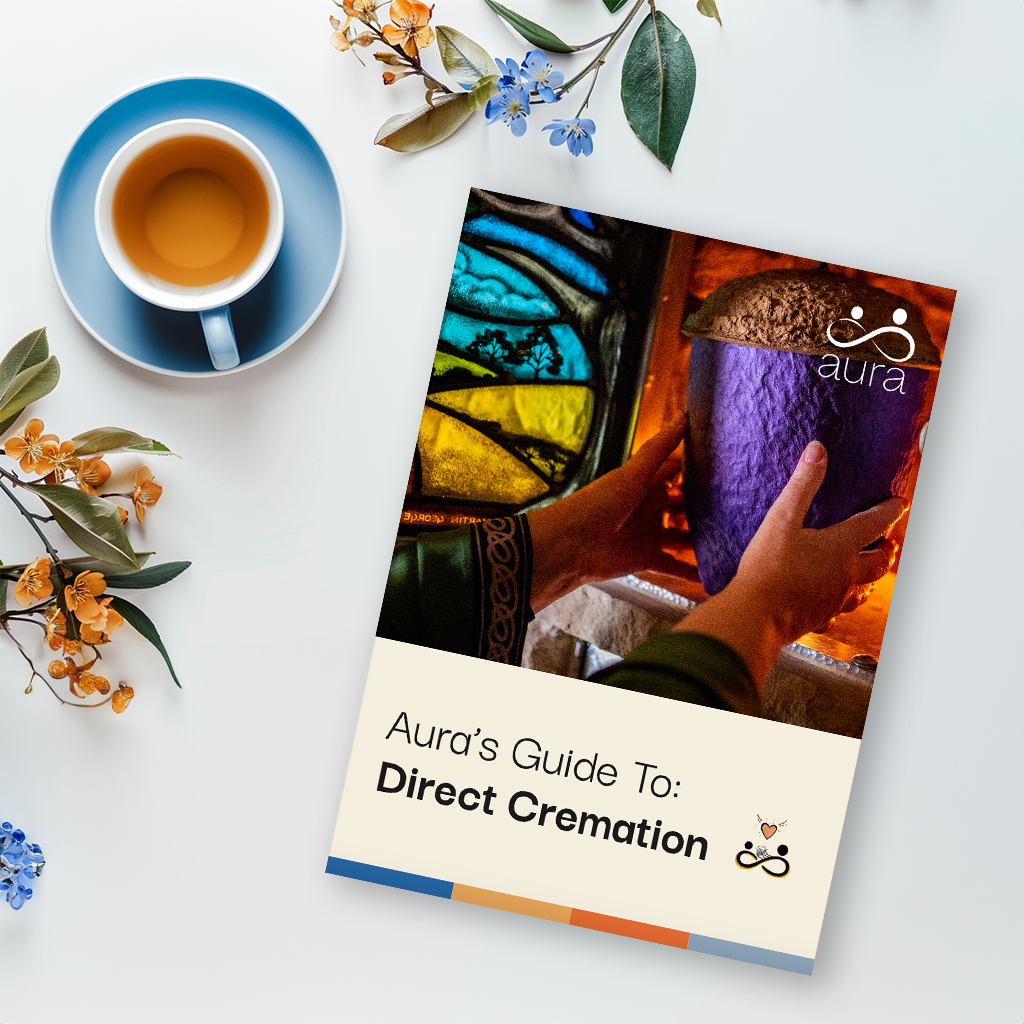
If you’d like more information about direct cremation and Aura’s funeral plans, then our downloadable guide can help. Find out why others are choosing this affordable, no-fuss alternative to traditional funerals and why it might be right for you too.
Download our guide by clicking the link below and learn more about this simple funeral plan option.
If you’re attending a memorial service, you might be unsure what to wear, whether to bring anything or if children are welcome. Memorials are often less formal than traditional funerals, but it’s always helpful to follow the family’s wishes.
What you wear will depend on the setting and tone of the gathering. Some families prefer traditional, darker clothing, while others may ask guests to wear bright colours or something that reflects their loved one’s personality.
You don’t usually need to bring anything unless the family has requested it. A sympathy card, flowers or a photograph of the person being remembered can be thoughtful gestures.
Some families may prefer donations to a chosen charity instead of flowers, so it’s worth checking the invitation.
Children are generally welcome at memorial services, although it’s best to check with the family beforehand.
If you’re bringing a child, explaining what to expect and giving them the opportunity to ask questions can help them feel more comfortable. You might also want to consider whether the setting and length of the gathering will suit their needs.
A memorial service gives family and friends an opportunity to remember someone they love, share memories and support one another. It can be a meaningful part of end-of-life planning, offering more flexibility than a traditional funeral.
A memorial can take place whenever the family feels ready, without the need to arrange everything shortly after a death.
This can be particularly helpful following a direct cremation, allowing loved ones to plan a personal celebration of life at a later date. Families can also include people who live further away through an online or hybrid gathering.
Coming together gives everyone an opportunity to share stories, celebrate the person’s life and reflect on what they meant to them.
For some, this can be a comforting part of dealing with grief. Although a memorial won’t take away the pain of losing someone, it can provide a meaningful moment to say goodbye and remember them alongside others.
Grief can feel isolating, particularly after the unexpected death of a loved one. A memorial offers family, friends and colleagues the chance to come together, share their experiences and support those who are grieving.
It can be especially comforting for someone coping with the death of a parent or another person close to them, reminding them that they don’t have to face their grief alone.
Memorial services offer the freedom to remember someone in a way that reflects their personality, beliefs and interests.
Whether it’s a quiet gathering, a favourite song or an occasion filled with shared stories, these personal touches can help celebrate the relationships, memories and moments that made their life special.


A memorial service in the UK typically begins with a welcome from a celebrant or family member, followed by eulogies, readings or tributes, music (live or recorded), and a sharing of memories. Services are highly flexible, there is no standard format, and can be secular or include religious elements. They often conclude with a reception or gathering where attendees can share stories and support one another.
Most memorial services last between 30 minutes and two hours, though there is no set rule. A simple, intimate gathering might last less than an hour, while a more structured service with multiple speakers, music, and a reception could take considerably longer. The length is entirely at the discretion of those organising the service.
A memorial service may also be called a celebration of life, a tribute service, a remembrance service, a memorial gathering, or a commemoration service. These terms are often used interchangeably, though a celebration of life tends to place particular emphasis on honouring the person’s character and achievements rather than mourning their loss.
A memorial service can be a good alternative to an attended funeral ceremony. Many people feel that a funeral forces them into a formal state of mind, or to gather and mourn before they’re ready. Others simply don’t want to make a fuss by having a funeral, but accept that it’s natural for others to want to gather and mourn their loss. A memorial service offers a personalised, flexible option in both cases.
This is entirely up to the family concerned. It could be held weeks, months, or even years after the death of the person, and could even be repeated on an annual basis as part of a memorial ritual or tradition.
The beauty of a memorial service is its flexibility. It’s completely up to the family to decide whether this is appropriate or not. Whilst traditional funerals are normally actively religious, the alternative doesn’t have to cut this out altogether. Religious scripture and music can be balanced with other things, as the family sees fit.
The only thing that needs to be borne in mind here is that, if you intend to hold a memorial service on private property which you don’t own, then you should seek permission from the owner. The same is true, depending on what you’ve got planned, if you want to arrange something in a public place. In particular, this is the case when scattering ashes. As a sidenote, whilst it’s a popular cremation myth that ashes are dangerous, they can be harmful to local ecology, so be mindful of this before scattering them in local beauty spots.
Memorial services are generally less formal than traditional funerals, so there are few strict rules. Smart-casual dress is usually appropriate unless the family has specified a theme or colour. It is courteous to arrive on time, silence your phone, and follow the lead of the family on tone, whether that is solemn or celebratory. Sending a card or flowers beforehand is a thoughtful gesture, and many families appreciate a short note sharing a memory of the person who has died.