×

Plan ahead and save up to £200 Save up to £200 on selected funeral plans until 31 October. T&Cs apply. Click here for full details.

Two Together: Save £100!Save £100 when you purchase two funeral plans together. Call us for more details.


Written by Adam McIlroy.
15 minute read

Funeral waiting times in the UK can vary, with most funerals taking place within one to three weeks after someone dies. However, some families may face longer delays depending on the circumstances. Understanding how long it takes to arrange a funeral can help you feel more prepared during an already difficult time.
When someone you love dies, waiting for their funeral can add to an already emotional experience. You may be wondering when the service can take place, what needs to happen first and whether there’s anything you can do to avoid delays. Whether you’re arranging a traditional funeral, considering direct cremation or planning ahead with a prepaid funeral plan, knowing what to expect can offer some reassurance.
In this guide, we’ll explore average funeral waiting times in the UK, what can cause delays and the steps you can take to help arrangements go as smoothly as possible.
Key takeaways:
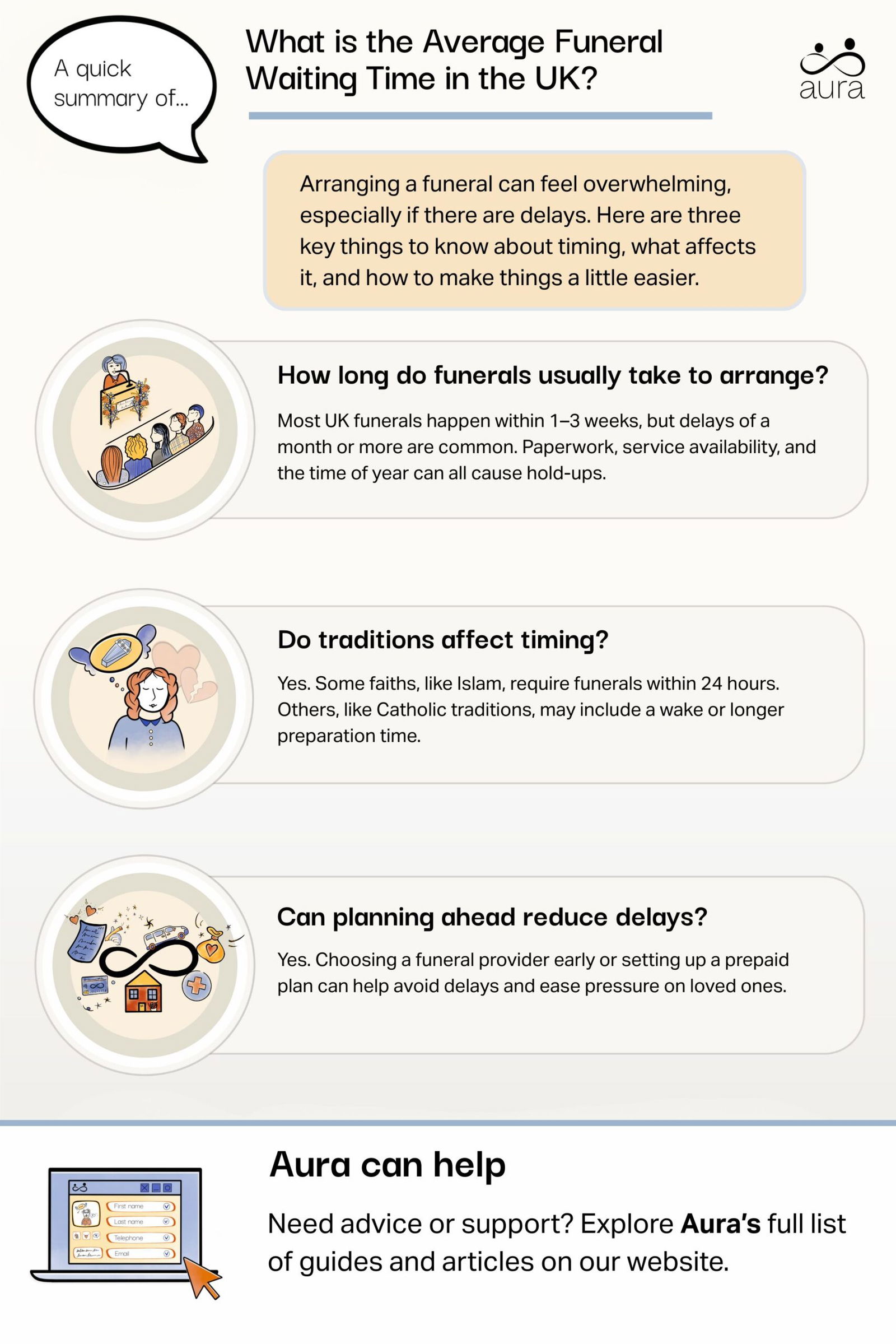
Funeral waiting times have changed over the years, and how quickly a funeral takes place can depend on family traditions, religious beliefs and the availability of local services.
The traditional funeral wait time in the UK has typically been between one and two weeks after the death of the person, which answers a common question about how long after death a funeral usually takes place. For cultural and historical reasons, in years gone by, funerals were generally arranged more quickly, allowing people a chance to view the body of their loved one beforehand, without embalming (it’s a popular funeral myth that embalming is legally mandatory). In accordance with different beliefs on death and funerals in religion, such as in catholic cultures like Irish or Italian, there is still the practice of holding a wake before the funeral. That is, displaying the dressed body in the family home within the local community, prior to the funeral, allowing locals to visit and pay their respects.
In Islamic culture, the body is buried as soon as possible after the death, with some British councils even allowing an expedited process to accommodate this. The body is displayed for a short period of time at home before being buried. This is as much due to the fact that, for Muslims, an important spiritual period of judgement awaits the person who has died, which can only take place in their grave.
When looking at current funeral waiting times in the UK, research conducted by the National Association of Funeral Directors suggests that almost half of all UK families seeking a funeral wait for over three weeks for a funeral to take place, with 14% waiting for one month or more.
At Aura, we recognise that this is far beyond what could be considered a reasonable length of time to wait for a funeral. Excessive waiting times can obviously have a detrimental impact on how we cope with the death of a parent or other loved one. If your loved one has died, once we’ve been appointed, we strive to collect them from anywhere in mainland Great Britain as soon as possible, with urgent collection options available for those who’ve passed away somewhere without mortuary facilities (i.e., outside of a hospital or care-home setting). Our industry-leading Aura Angels are expert, compassionate funeral arrangers who can assist with all aspects of funeral-related admin, ensuring that everything is handled as quickly and as diligently as possible.
There are a whole host of factors, most of which beyond the control of your funeral director, which can impact the average funeral waiting time in the UK.
Those who’ve organised a funeral before will know that they require an unexpectedly large amount of administration. When someone dies, it kickstarts a very long chain of documentation, starting with the ‘Medical Certificate of Cause of Death’ (MCCD). It is a medical document that outlines the ‘Cause of Death’ of the person who has died, and is issued by the physician attending the person when they died, before being verified by a second doctor called the ‘Medical Examiner’. They will then send this certificate to the Registrar’s office at the council local to where the death occurred, which allows you to begin the process of formally registering the death.
If the ‘Medical Examiner’ disputes the ‘Cause of Death’ given by the attending physician, or if they are unable to explain the circumstances of the death, they may refer the matter to the Coroner (‘Procurator Fiscal’ in Scotland). The Coroner may launch an investigation into matters, as well as an ‘Inquest’. Naturally, if things go down this road, it could add delays to the funeral waiting time that you will experience. As a side-note, it could be useful to get a cremation forms guide or to start a funeral checklist if you are arranging a funeral, as it can be much easier to keep things organised this way.
Many families understandably ask how long it takes to get a funeral date, and this often depends on crematorium or cemetery availability in their area. Direct cremation is a form of funeral that, with the decline of religion in the UK, has increased significantly in popularity compared to the traditional funeral. This increased demand puts greater strain on the availability at crematoria around the country. According to SunLife, last year 73% of British funerals were cremations of one kind or another.
If there are public holidays, such as Christmas Day or Easter Monday, this can impact crematoria or cemetery opening times, and usually means that a cremation or burial service can’t be held on that day. Make sure to be aware of when the public holidays are around the time you are likely to have a funeral in order to avoid unexpected delays. Be aware also of the different sets of public holidays in England and Wales compared to Scotland.
It follows also that demand is bound to be higher in more urbanised areas of the country compared to more rural areas, as, put simply, more people live there. According to Legal & General, the average cost of a funeral varies quite significantly by region, with the average cost of a burial and cremation in Greater London being ~£8,800 and ~£5,000 respectively, whereas the cost for the same services in Wales was ~£5,000 and ~£3,900. Much as with increased costs, increased time delays are seen in more urban areas compared to rural areas, as more people attempt to share fewer resources. In general, funeral services are required more frequently during the winter months, so it can help to bear the potential delays of this in mind too.

Arranging a funeral in the UK typically takes around two weeks, although the process can be shorter or longer depending on your circumstances. You don’t need to organise everything at once, and a funeral director can help you work through the arrangements at your own pace.
Once the initial formalities are underway, there are a few practical decisions to make:
You can begin making these decisions while the necessary paperwork is being completed, so there’s no need to wait before seeking guidance. Although how long it takes to arrange a funeral will vary from family to family, having a clear idea of the steps involved can make the process feel more manageable.
Remember, there’s no need to rush every decision. Taking time to consider what feels right for your loved one and your family is an important part of arranging a meaningful farewell.
The type of funeral you choose can sometimes influence how quickly it takes place. Burials can occasionally be arranged sooner, as they are not dependent on crematorium schedules. Cremations may involve longer waits simply because of demand and limited availability.
Options such as direct cremation can offer more flexibility, as they do not involve a service at the crematorium. It’s important to remember that timing does not reflect the level of care or respect given to the person who has died. Every funeral, regardless of format, is handled with dignity.
There are a number of things which you can do to minimise the impact of funeral waiting times and delays on your own arrangements, from engaging as early as possible about what you would like from your funeral director, as well as by planning ahead.
Whilst it’s impossible to know in advance exactly when a funeral is likely to be needed, it’s important to try to put arrangements in place as soon as you can after the need arises. By selecting a funeral director, e.g., for direct cremation, as early as possible, you will be more likely to secure the dates that you would prefer, and you will get a head start on the necessary paperwork. Compare direct cremation providers and costs to make sure you are getting the most for your money.
Understanding how long cremation takes can also help set expectations, as providers need to allocate cremator time carefully when confirming available dates.
You can get even further ahead by planning out funeral matters, for instance for your own funeral, as soon as possible. If you’ve ever wondered what a funeral plan is, it’s a simple way to make arrangements in advance and protect your loved ones from rising costs and last-minute decisions. A prepaid funeral plan allows you to specify your funeral preferences (cremation vs burial, attended or unattended, which funeral director you’d like) and pay for everything in advance, locking in today’s prices. Given that SunLife have charted a 126% increase in funeral costs over a 20-year period, this is no small advantage.
By nailing down the specifics beforehand, a lot of the potential for delay is headed off in advance. Your family simply needs to push ‘play’ on your funeral plan, and the funeral director will take care of the rest, giving them real peace of mind.
We hope that this article has helped you feel more familiar with the average funeral waiting time in the UK, and how to minimise it. If you are organising a loved one’s funeral in the here and now, we want you to feel as reassured and knowledgeable as possible about what to expect and how long does it take to arrange everything.
If you’d like our help with making funeral arrangements, whether today or as part of a prepaid funeral plan for the future, our Angel team is always on hand to take your call. We are the UK’s top-rated ‘Cremation Services’ provider on Trustpilot with 4.9/5 stars. And it’s the compassion and expertise of our Angels which has earned us that recognition.
We are also proud of the fact that Aura is a family-run company. Paul Jameson founded us back in 2019, after he was forced to confront motor neurone disease and his own mortality. He wants to pass on the benefits of what he’s learned to each family in the UK struggling with legacy planning. He still runs the company today alongside his son, Dave (our CEO), and Ben (our COO), a family friend. Every day, we strive to offer nothing less than the service Paul would want for his own family, to everyone in our care.
If you’d like our support with funeral arrangements, or with the paperwork that funeral arranging can generate, please feel free to give us a call. We’re here to help.
If you’d like to know more about how to plan a cremation with Aura, our brochure is a helpful place to begin.
Our funeral plans are a helpful way to put everything in place for you or someone else.
When the time comes, our experienced team will be here to guide you through each step, offering support and advice whenever you need it.
To find out more about how our plans work, what’s included, and our story, you can request a brochure by clicking the link below. We will then send you a copy by email or First Class post—whichever you prefer.
Most funerals in the UK are held within 1–3 weeks after someone’s death. However, it’s not uncommon for wait times to stretch to a month or longer, especially in busy urban areas or during winter.
Several factors can delay funerals, including:
Legal paperwork (e.g. registering the death, coroner involvement)
Availability at crematoria or burial sites
Public holidays or seasonal demand
Religious or cultural traditions
Urban demand (longer waits in cities than rural areas)
Yes. Waiting several weeks for a funeral is now very common in the UK. While this can feel unsettling, it does not lessen the meaning of the goodbye.
For many families, extra time allows space to reflect, gather loved ones, and create a farewell that feels right. Taking the time you need is not a failure, it’s often an act of care.
Yes. You must have the Medical Certificate of Cause of Death (MCCD) and register the death before a funeral can go ahead.
If the death is referred to a coroner (e.g., if the cause is unclear), this can result in delays until the investigation or inquest is complete.
Yes. In larger cities, funeral services are in higher demand, leading to longer wait times. For example, funerals in London often take longer to arrange than in rural parts of Wales or Scotland.
Yes. Winter months often see a rise in the number of deaths, increasing demand on funeral services and potentially causing delays. Also, bank holidays can reduce availability at crematoria or cemeteries.
Absolutely. Islamic funerals, for example, require burial as soon as possible. Many UK councils offer expedited services to accommodate these requirements when possible.
Engage a funeral director early (as soon as the death occurs or is expected).
Prepare documents in advance (start a funeral checklist).
Consider a prepaid funeral plan to lock in services and avoid delays when the time comes.
Not directly, but prepaid plans can help you avoid delays by securing arrangements early and locking in today’s prices.
Not necessarily. Burials can sometimes take place sooner because they don’t rely on crematorium availability.
In contrast, direct cremation can sometimes be arranged more quickly than a traditional funeral because it does not require a service, attendees, or coordination around a specific ceremony time.
Yes, weekends and bank holidays can affect funeral timings, as crematoria, cemeteries, and registry offices may have reduced availability.
This can sometimes add a few extra days to the process, particularly around Christmas, Easter, or other public holidays. Funeral directors are used to planning around these dates and will guide families through what to expect.
Delays around holidays are common and do not mean anything has gone wrong.