×

Two Together: Save £100!Save £100 when you purchase two funeral plans together. Call us for more details.

Written by Emily Cross.
19 minute read

Marking the death of someone you love is often a challenging period. Grief is personal, and everyone processes it differently, but certain customs can offer comfort and connection during this time. One of these is the funeral wake: a gathering that traditionally took place before the funeral, though today it’s just as often held afterward.
A funeral wake offers space to mourn, reflect, and share memories away from the structure of the service itself. Planning one can feel overwhelming when emotions are still raw, but it may also help you shape how your loved one is remembered — quietly, warmly, and in a way that feels right to you.
Families across the UK who use our direct cremation services to provide flexibility and choice often find that doing so gives them a greater sense of freedom when it comes time to plan the wake. While we are always here to help by providing such services, our primary goal is to help you find support, guidance, and perhaps even some ideas to consider.
Key takeaways:
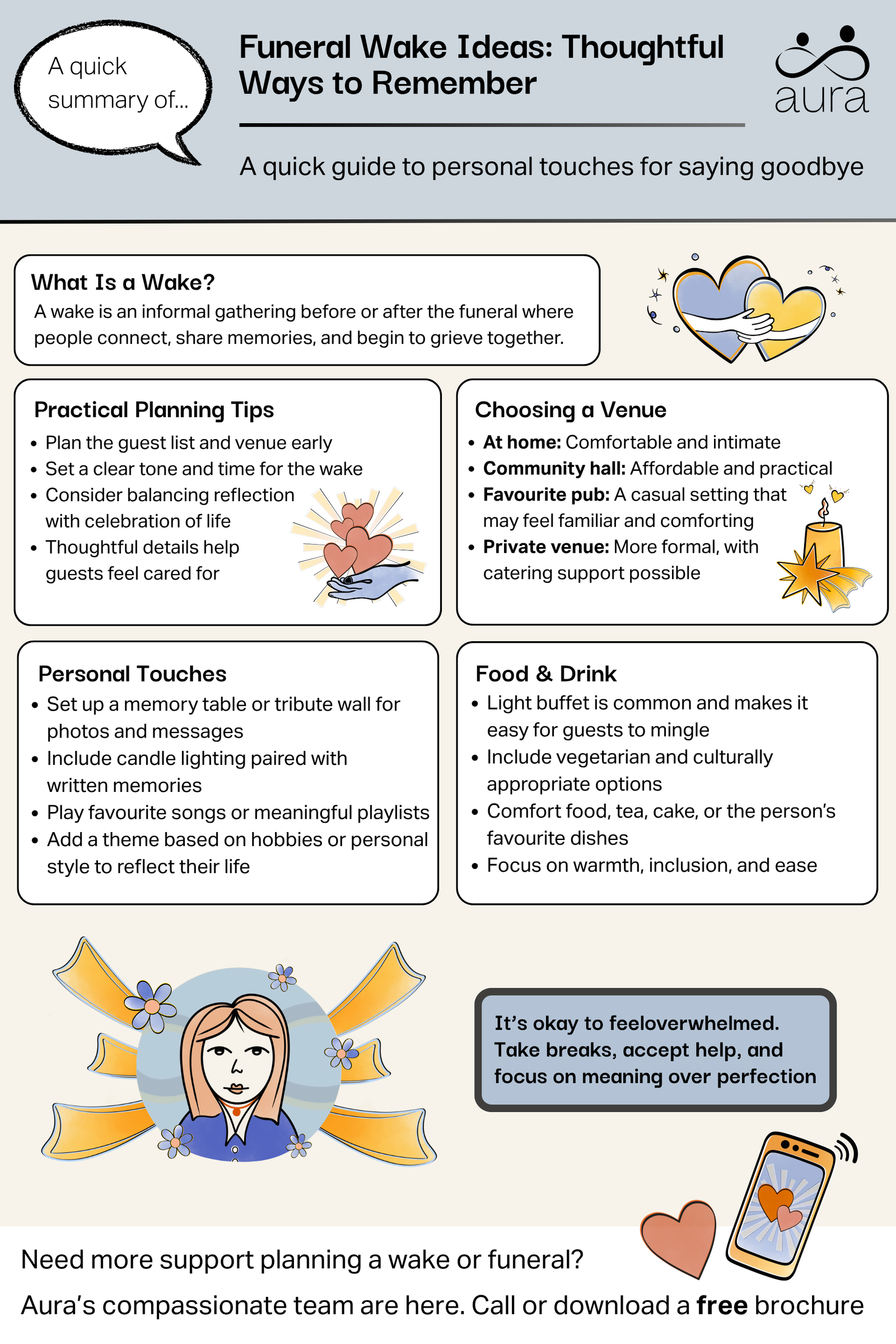
The wake is one of the long-standing British funeral traditions that many reading this may already be familiar with, and it represents a chance for each mourner to say their goodbyes in a personal way.
Although the funeral service is often the main point of focus, it will typically be shorter and more formal than the wake with funeral songs, readings, and potentially religious or culturally significant rituals providing an overarching structure. Even non-traditional funeral services will typically have a structure and timeline that will be laid out in the order of service.
Wakes offer an opportunity for family and friends to gather and remember the person who has died by sharing stories, talking about memories, or just providing a listening ear to one another. It may also serve as a chance for relatives and family members to reconnect and catch up regarding other matters if they have not seen one another for some time. Some may find that doing so provides a welcome reminder that, despite a painful sense of loss, there is still much to look forward to in the future.
Different people, cultures, and religions have traditional practices that they may wish to follow. If your family extends across a variety of different cultures and religions, you might find it’s helpful to consider traditional elements that various family members may appreciate or expect. Below are some common examples that may prove insightful.
The Jewish faith prescribes a seven-day mourning period that is referred to as ‘sitting shiva‘. During this time, it is customary for mourners to remain at home and receive visitors from the wider family, friends, and also prominent members of the community. It is typical for sitting shiva to be a solemn, quiet, and reflective period where significant time is devoted to deep reflection and traditional prayers. Many Jewish people will choose to think deeply about the life, character, and achievements of the person who has died.
A traditional Irish wake is punctuated by extended storytelling that is designed to help the next of kin hear about different sides of their loved one. Mourners typically arrange a time to come to the house and pay their respects, while the person who has died is often placed in a coffin for several days for viewing.
Those who visit will typically stay for a cup of tea and talk informally about their memories of the person who has died. Often, the conversation will take the form of an extended story that takes several twists and turns, allowing those mourning to think and reflect on the many sides of their loved one’s personality and approach to life.
For those from British Caribbean communities, a wake will typically involve a week-long celebration where extended family and friends gather and socialise, often sharing gifts and heartfelt remembrances. Known as the “Nine Nights,” it’s a time of live music, home-cooked meals, and telling stories and sharing memories. The mood, while it varies from one family to the next, is more a celebration of life than the more solemn affair that is the traditional British wake. Many find that adopting this approach helps them to begin to process their emotions and come to terms with what has happened.
Sikhs will often see death as a natural step towards entering the afterlife and, as such, they will take a spiritually reflective approach to a wake, often incorporating elements of remembrance. Most of the time will be devoted to a combination of readings from the Guru Granth Sahib and large communal meals with family and friends. Coming together is central to Sikh culture and is something that many find can help them find support and a listening ear when they need it most.
The Islamic faith focuses primarily on immediate burial and the need to wash and cleanse the body as quickly as possible. As a result, a wake may not take place, although some choose to have a post-funeral gathering once their loved one has been buried. This is very much up to the next of kin and a choice that should be respected by all those who are in attendance.

Many aspects of British funeral etiquette are changing and evolving, making many of our non-traditional funeral ideas increasingly common among some families. This may present you with a variety of different options to consider not just in terms of the style of wake, but in terms of the venue itself.
Creating a comfortable and respectful atmosphere at home may be a case of opening up your main living room and dining room to create a communal space for all of your visitors. The idea is to make people feel welcome and give them the freedom to circulate between several rooms so that they can talk to their fellow mourners and share their thoughts and feelings.
Sometimes having a central point of focus may help to give something for people to talk about as a way of breaking the ice and opening up. A memory table with photos and keepsakes could help your fellow mourners remember memories and share life stories. You may also find that curating such a table helps you to begin to process your emotions as well.
Providing a selection of food is something else you may wish to consider. As the host, you have the choice to cater for your guests or to opt for catered food. While the choice is yours, you may find that the time saved by a catered option gives you a little more space to think and reflect in the days before the wake.
One of the common causes of funeral arrangement disagreements is a choice of venue that is seen to be insensitive or inaccessible to certain members of the extended family. With this in mind, you may find it helpful to discuss the pros and cons of the following types of wake venues with a close friend or relative:
There is no right or wrong choice here, but it may be helpful to consider where the majority of the mourners live and how many you expect there to be. Finding a venue that puts you at ease, is easy to get to and from, and has a team who are sensitive to your needs can make a real difference as you prepare for what may prove to be an emotional day. You may also wish to speak with your funeral director, who can often help coordinate timings between the service and the wake.
Wondering how to plan a wake that reflects someone’s life and brings people together? Whether you’re thinking about a relaxed gathering or something more structured, this section offers ideas to help you shape the event in a way that feels right for you.
We’ll cover everything from funeral wake decoration ideas, meaningful activities, and music choices to living wake ideas for those planning ahead. Whether you’re planning a funeral reception or wake, or simply looking for thoughtful wake decoration ideas, there’s no right or wrong – just what feels personal and comforting.
Setting up a memory jar/book or tribute wall for guests to share messages may help you provide a space in which many in attendance feel comfortable opening up. Because everyone shares their thoughts and feelings in their own way, having a mixed-media option will allow everyone to settle on something they feel comfortable with. If you wish to curate something in advance to get things started, you may find it helps to work with a couple of friends and relatives so that you can share ideas.
Another option you may wish to consider is the symbolic act of lighting candles. Offering everyone the chance to light their own tea light and then writing a memory and placing it in a nearby jar can be a way to slowly continue with the grieving process. The flickering of the flames and the option to read back the notes in the years ahead are two things that you may wish to think about as you try to decide what feels right.
A themed wake could include a hobby of the person who has died was known for and allow it to become more of a celebration of life than a formal, solemn occasion.
Accompanying this with a playlist informed by their favourite songs, and a light buffet of their favourite food and drink may be a way of helping your fellow mourners feel closer to them. This is something that many families feel comfortable with, especially in the case where the person who has died was young, as it allows for heartfelt remembrance. You may also find it helpful to take a look at our guide that covers DIY funeral flowers if you are looking for ways to decorate that you feel are appropriate.
Small thank-you gestures can be a lovely way to acknowledge those who came to support you and honour the person who has died.
You might consider offering a keepsake for guests to take home, something simple and meaningful. Ideas include a bookmark with a photo, a small candle, a packet of seeds, or even a recipe card featuring a favourite dish. These little touches can help people feel connected and remembered long after the day itself.
A funeral wake will, generally speaking, be a light buffet that allows people to circulate and talk more freely than a formal sit-down meal. While the choice is yours, you may find that the social element of a buffet helps mourners of all ages feel more at ease and can even provide a sense of release after the formality of the service.
Laying out a variety of sweet and savoury options, including a few pieces for those with special dietary requirements, gives everyone the freedom to nibble and work their way around the room. Taking a moment to consider any family traditions or cultural elements you need to be aware of can help you make a choice that will be welcomed by all in attendance.
Much like planning the service becomes a little easier when you have a better idea of what happens at a funeral, the same is true of the wake. Although you have the freedom to plan and host in any way you see fit, it may prove helpful to give a little thought to the traditions and common practices so that you can accommodate the wishes and expectations of the various mourners.
The rather open-ended nature of planning and personalising a wake may provide its own difficulties in the form of an expansive range of choices and options. If you feel like you want a little more direction, you may find it useful to consider a few key elements:
Putting pressure on yourself to deliver the ‘perfect’ wake is only natural. You want to remember your loved one in a way that befits their memory, but you also need to be aware of your own emotional needs at this time. While we never wish to dictate how you grieve or prescribe a course of action, you may find it helpful to take moments to sit and reflect on how you are feeling.
Some people will find that keeping busy and keeping an active role in planning the wake can provide a sense of balance and focus, perhaps even a welcome distraction from intense emotions. Sometimes the simple act of checking in with yourself by keeping a journal can help you ensure that you’re meeting your own needs rather than running the risk of burning yourself out. The more active you feel you can be with regard to your own self-care, the more you will be able to contribute to the planning process as the day approaches.
As a family-run funeral provider that takes a great deal of pride and care in making sure that everyone we serve is looked after, we believe that our services extend far beyond mere arrangements. With this in mind, we sincerely hope that this guide has provided you with ideas, guidance, and support at a time when we believe you may need it more than ever.
The death of a loved one naturally can cause a complex series of emotions that we have to work through, and to some, it may lead to a period of deep personal reflection. Thinking about our lives and the legacy we may leave behind for the people who love us is something that many people do at such a time.
If you have found that you want to help those you leave behind know your intentions and process their loss, you may consider our prepaid funeral plans at a time when you feel ready.*
Regardless of what stage of your journey you are at, or how you are feeling right now, we are always here to help you find a path forward that feels right. We feel it’s the least we can do at a time when you may understandably feel like you have more than enough on your shoulders.
*Terms and conditions apply. You will receive a funeral plan summary before purchase.


If you have any questions, would like a brochure or simply would like a chat through our services, our award-winning team is here to help.
Unlike other providers, we won’t hassle you with constant calls. We’ll simply ensure you have the information you need and leave you to come to a decision in your own time. When you’re ready for us, our team will be ready to help.
Our team is available Monday–Friday, 9.00–5.00pm.
Some families may decide that they want the wake to be a celebration of the life their loved one led and to showcase several tributes to their hobbies and passions. Photos that tell a story of their life, an in-depth “This is Your Life” open mic, and a memory table are all ways you may wish to consider doing this. Others may decide that they prefer symbolism, in which case planting a memorial tree or releasing some doves into the air and watching them take flight may be deemed more appropriate.
There’s no set cost for a wake, as it depends on the type of gathering you choose and how many people you plan to invite. Some families host a small get-together at home with homemade food, while others hire a venue and arrange catering.
If you’re choosing a private venue with food and drink for a larger group, the cost could be higher. Some people find that arranging a direct cremation first gives them more freedom and flexibility to plan a wake that feels right, in their own time and space.
Whatever you decide, it’s worth remembering that there’s no right or wrong way to hold a wake. Simple or elaborate, it’s about creating a moment to come together, share memories, and honour the person who has died.
Usually, the person organising the funeral also arranges and pays for the wake. This is often a close family member or someone named in the will.
Sometimes, the cost is shared among relatives or friends who want to contribute. There’s no set rule – it depends on your family’s wishes, circumstances, and what feels manageable at the time.
However it’s paid for, the wake doesn’t need to be elaborate. What matters most is bringing people together to remember and honour the person who has died.
For a wake to be meaningful, it needs to honour the life of the person who has died in a way that will make the mourners feel comfortable, heard, and respected. While it is understandable to find yourself lost in the details when you want everything to feel perfect, sometimes the most important thing to focus on is a supportive and welcoming atmosphere that allows every mourner to feel like they can open up as they see fit.
Traditionally speaking, the wake would take the form of a gathering that is held before the funeral. For centuries it has been a time when friends and family of the person who has died meet, either together or in smaller groups, to pay their respects and say a personal goodbye. More recently, wakes have become more social in nature, with many of them taking place after the funeral service at a nearby venue such as a pub, hotel, or community hall.
A traditional pre-funeral wake is something that some may take comfort in as it provides a sense of tradition and formality that can provide reassurance and support. The person who has died will typically be viewed in their coffin — either at home or in a funeral home — while the home in which the wake will take place will be set up for an understated and respectful affair. Common traditions are leaving one window open for a soul to move into the world, stopping all of the clocks that are on display, and covering the mirrors with a cloth.
A funeral wake may take any form you wish, but you might feel unsure about which activities or customs you would like to include. With this in mind, we think you may find it helpful to consider a shortlist as a means of finding inspiration: