×

Plan ahead and save up to £200 Save up to £200 on selected funeral plans until 31 October. T&Cs apply. Click here for full details.

Two Together: Save £100!Save £100 when you purchase two funeral plans together. Call us for more details.


Written by Adam McIlroy.
18 minute read

Article reviewed by Steven Barratt, Founder of Save Funeral Costs on August 14, 2025.
Funeral costs in the UK are rising, making the cost of arranging a funeral an understandable concern for many families. At an already difficult time, worrying about how you’re going to pay for a funeral can add even more pressure.
So, why are funeral costs rising, and what is behind the increase in funeral prices? In this article, we’ll look at some of the main factors affecting funeral costs in the UK, how prices are changing and what your options are if you’re concerned about the cost of a funeral.
If you’re researching funeral costs because someone you love has died, we know this may be a difficult time. We’re here to make things a little clearer and help you understand your options.
Aura is the top-rated ‘Cremation Services’ provider on Trustpilot, with a score of 4.9/5 stars. We offer funeral services for those who need to arrange a direct cremation now, as well as prepaid funeral plans for those thinking ahead.
Key takeaways:
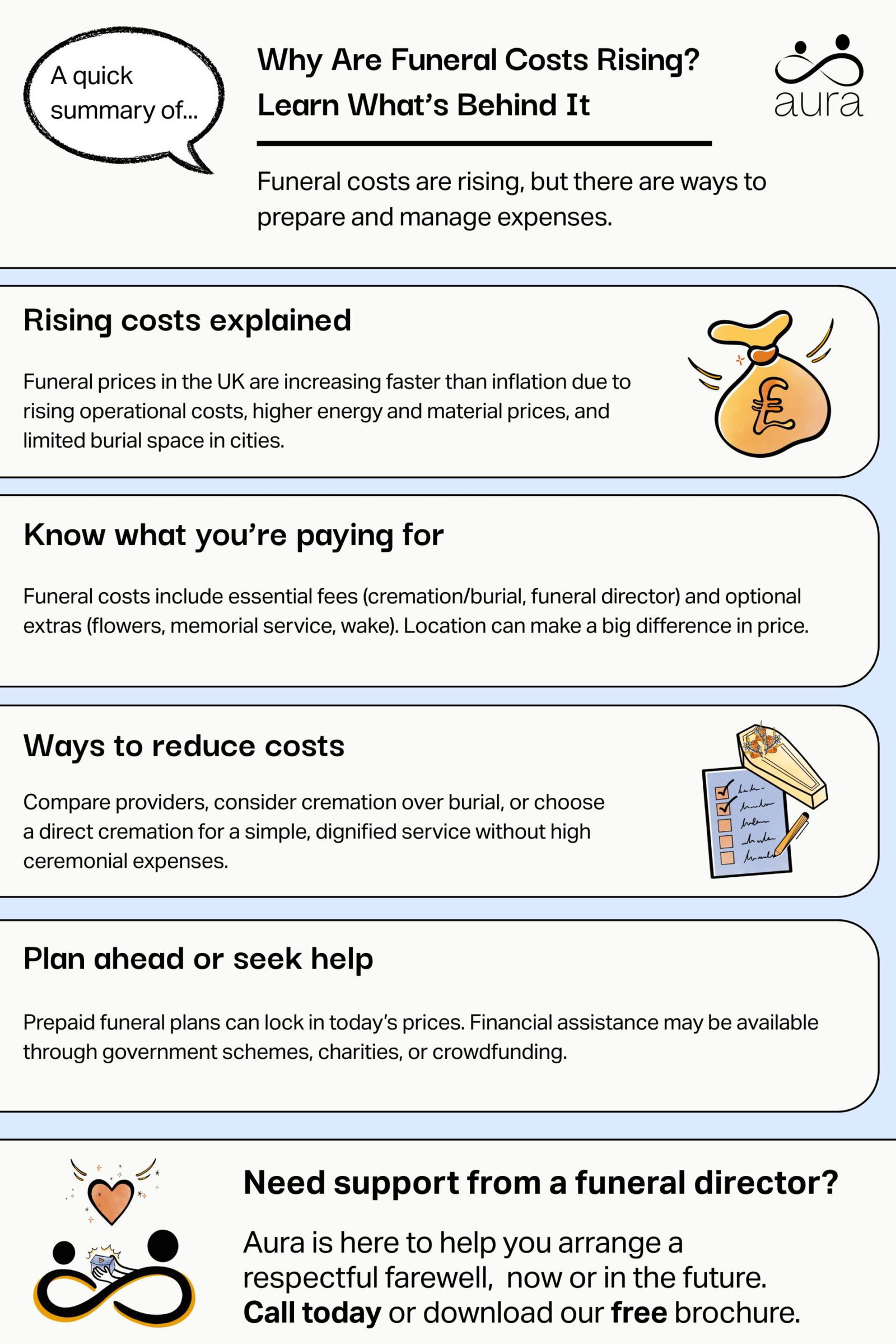
The cost of a funeral in the UK can vary depending on the type of funeral you choose, where you live and whether you include optional extras. According to SunLife’s 2026 Cost of Dying Report, the average cost of a simple attended funeral is £3,828. When the average £1,312 spent on send-off extras is included, the national average total funeral spend rises to £5,140.
Legal & General’s annual funeral cost research estimated that, in 2024, the average cost of a cremation in the UK was £4,431, while a burial was typically higher at around £5,894. This reflects an annual increase of 6.1% for cremation and 7.3% for burial compared with 2023.
Here’s how the latest UK funeral costs compare:
| Funeral cost | Average cost |
|---|---|
| National average total funeral spend | £5,140 |
| Simple attended funeral | £3,828 |
| Direct cremation | £1,628 |
| Simple attended burial | £4,758 |
| Simple attended cremation | £3,518 |
*Figures taken from SunLife Cost of Dying Report 2026*
These averages can be a helpful starting point when planning a funeral, but the amount you pay will depend on the arrangements you choose. For example, a direct cremation is usually a lower-cost option because there is no attended funeral service at the crematorium. A burial with a service typically costs more.
If you’re looking for a more detailed breakdown of funeral costs, you can download our free funeral costs guide.
A funeral cost breakdown can help you understand where your money goes and which costs you may have more control over. The final price will depend on the type of funeral, your chosen provider, where you live and any additional services you choose.
Not every funeral will include all of these costs. For example, a direct cremation usually has fewer elements than an attended funeral, which is one reason it can cost less.
There is no single price for a funeral. Several factors can affect funeral costs, from the type of service you choose to where the funeral takes place.
One of the biggest factors is whether you choose an attended or unattended funeral. A traditional attended funeral may include a service, funeral procession and other arrangements, while a direct cremation takes place without mourners attending the crematorium. With fewer services involved, direct cremation will usually cost less.
Whether you choose a cremation or burial can also make a significant difference to the overall cost. Burial is typically more expensive, as costs may include a burial plot and grave preparation as well as the funeral itself. Local cemetery fees can vary considerably.
Funeral costs can vary depending on where you live, as funeral director, crematorium and cemetery fees differ across the UK. Understanding how location affects funeral costs can help explain why families in different parts of the country may pay different amounts for similar funeral arrangements.
Funeral providers structure and price their services differently. Some offer packages that include most of the arrangements, while others charge separately for individual services. When comparing funeral costs, it can help to look closely at what is included in the quoted price rather than comparing the headline figure alone.
Flowers, transport, a wake, printed orders of service and other personal touches can make a funeral feel more individual, but they can also increase the overall cost. For example, Funeral Guide estimates that floral tributes can cost between £40 and £400, depending on the arrangement you choose.
There is no requirement to include these extras, so you can choose what feels right for the person who has died, your family and your budget.
Since SunLife first published its Cost of Dying Report in 2004, the cost of a funeral has risen by 146%. A number of factors are behind this increase, from higher energy and staffing costs to rising crematorium and cemetery fees.
Like many other sectors, the funeral industry is affected by inflation. When the cost of energy, fuel, wages, materials and running premises increases, funeral providers, crematoria and cemeteries can face higher costs too. These increases can ultimately affect the price families pay for a funeral.
Funeral services rely on both energy and transport. The cremation process itself requires high temperatures, so energy is an important part of how a crematorium works. Funeral providers also use vehicles to bring the person who has died into their care and for funeral transport. As energy and fuel prices rise, these day-to-day costs can contribute to higher cremation costs and funeral prices more widely.
Burial space is limited in some parts of the UK, particularly in larger cities where available cemetery plots are becoming harder to find. With fewer plots available, burial fees can be higher and may continue to rise as space becomes more limited.
There can also be significant regional differences in burial costs. According to Legal & General, a burial in Greater London can cost around £9,000, compared with around £5,000 in Wales or the East Midlands, a difference of approximately £4,000.
Arranging a funeral can be an emotional experience, and many families feel a strong sense of responsibility to provide a meaningful farewell. Sometimes, this can lead to spending more than they had planned.
According to SunLife, 97% of funeral directors believe that families spend more than they need to. During a time of grief, it can feel difficult to compare options or question costs, which can make decisions feel more pressured than usual.
Funeral costs tend to be increasing year-on-year at a faster rate than inflation generally over the same period.
Sunlife have explained that funeral prices are approaching an all-time high. That’s because, since they began making their Cost of Dying reports in 2004, funeral prices have increased by 146%. When compared to the 82% by which inflation has increased in the same period, it shows that funeral prices have been increasing year on year at a significantly faster rate.
According to Legal & General, the average ‘cost of dying’ in the UK in 2014 was £3,616. By 2034, they anticipate an average price of £6,733. This would make the percentage increase in price between 2014 and 2034 ~86%. Naturally, these projections are based on how prices have been increasing historically, and past financial developments don’t necessarily indicate future performance. Nevertheless, with more global security the pressures on the world’s trade system and economies could lessen, seeing a corresponding reduction in inflation and costs.
One of the most notable changes in recent years is the rise of direct cremation. According to SunLife, this has grown from just 3% of all UK funerals in 2019 to 21% in 2025. This reflects a wider shift towards simpler and more affordable options. On average, a direct cremation costs around £1,628, compared with £3,828 for a simple attended funeral, which can help families manage costs more comfortably.
‘Why are funeral costs rising?’ and ‘Why do funerals cost so much?’ are often some of the first questions we ask ourselves when someone dies, particularly when faced with paying for their funeral ourselves.
Different providers of funeral services will structure their funeral or direct cremation prices in different ways, opting to include certain elements in the final pricing, or not. If you’re looking for a direct cremation in the near future, you can get a better sense of how each provider arranges their pricing by comparing direct cremation providers and their costs against one another.
For instance, some might charge extra for medical-device removal prior to cremation, where others like Aura, will cover this in the quoted price. Providers, depending on the type of funeral, may offer extra services, such as embalming for a final viewing, or the option of an attended ceremony. You can see what is included in Aura’s unattended direct cremation offering for those arranging a funeral in the short-term, below.
When arranging a funeral, there can be additional costs that are easy to overlook. They are not always ‘hidden’ fees, but they may not be included in the initial price you are quoted. Knowing what to look out for can make it easier to understand the overall cost and plan your budget.
Registering a death is free, but you will usually need to pay for certified copies of the death certificate. You may need several copies when dealing with banks, insurance providers and other organisations. For example, copies may be needed when making a claim through over-50s life insurance.
Some funeral providers charge extra if the person who has died needs to be brought into their care urgently or outside normal working hours. Ask whether collection is included in the quoted funeral price and whether any additional charges could apply.
Depending on the circumstances and where you live in the UK, there may be additional medical or administrative costs associated with a funeral. Certain medical devices may also need to be removed before cremation. Your funeral provider should explain whether any such costs apply and whether they are included in the price.
If you choose to have a celebrant lead the funeral or memorial service, their fee may be charged separately. The amount can vary depending on the celebrant and the type of service you are arranging.
Holding a wake or gathering after the funeral can add venue hire, food and drink to the overall cost. How much you spend is entirely up to you, and a meaningful gathering does not need to be elaborate or expensive.
Some costs come later. If you choose a burial, for example, you may decide to add a headstone or another memorial after the funeral. There can also be fees for installing a memorial or obtaining permission from the cemetery or burial ground.
If you’re worried about rising funeral costs, there are ways to arrange a meaningful funeral while keeping the overall cost manageable. Taking some time to understand your options and what you are being charged for can help you make choices that feel right for your family and your budget.
Funeral prices and the services included can vary between providers, so it is worth comparing direct cremation providers. Look beyond the headline price and consider what you actually need. You may also find it helpful to understand who is responsible for funeral costs before making any financial commitments.
A direct cremation is usually less expensive than an attended funeral or burial because there is no funeral service at the crematorium. It can offer a simpler alternative for families who do not want a traditional funeral or are looking for a more cost-effective funeral.
When considering your options, comparing cremation and burial can also help you understand the differences in cost and what each involves.
Choosing a direct cremation does not mean you cannot come together to remember the person who has died. You could hold a celebration of life afterwards, giving family and friends the opportunity to gather at a time and place that feels right.
This can also give you more control over the cost, as the gathering can be as simple or elaborate as you choose.
If you can’t afford a funeral, there are several places you can turn for help. Depending on your circumstances and where you live in the UK, you may be able to claim funeral costs through government support. You may also be able to use money from the person’s estate, seek help from charities or raise money with support from family, friends and your wider community.
If these options aren’t available and nobody is able or willing to make suitable funeral arrangements, a local authority may have a duty to arrange a public health funeral in England and Wales. You can find more practical guidance on the options available in our guide to how to pay for a funeral with no money.
Here are some of the main forms of financial support you may be able to consider:
If you live in England, Wales or Northern Ireland and receive certain benefits or tax credits, you may be eligible for the government’s Funeral Expenses Payment. This can help towards some of the costs of a funeral, although it may not cover the full amount.
In Scotland, eligible people may instead be able to apply for the Funeral Support Payment.
If your husband, wife or civil partner has died, you may be eligible for Bereavement Support Payment. Eligibility depends on your circumstances, so it is worth checking the current government guidance.
You may also be able to use money from the person’s bank or building society account towards their funeral. In some circumstances, the bank can pay a funeral invoice directly from the account before probate has been granted.
Charities may be able to offer advice or help you find financial support. Quaker Social Action can provide guidance around funeral costs, while Cruse Bereavement Support offers support following a bereavement.
Crowdfunding is another option some families consider. Platforms such as JustGiving and GoFundMe allow friends, relatives and members of the community to contribute towards funeral costs.
At Aura, we are proud of our compassion, patience and kindness in our service. Our wonderful Aura Angel team are the champions of our approach, and they’ll be there to guide you or your family through the difficult experience of funeral arranging. They’re not only experts in funeral coordination, but can lend you an ear if you need to talk about what’s on your mind. We’re there for you on the phone, whenever you’re ready.
Aura is a family-run company, founded by Paul Jameson in 2019 after following his motor-neurone-disease diagnosis. He set up Aura wanting to help families in the UK to benefit from his confrontation with his own mortality, and his experience with end-of-life planning. He runs the company today alongside his son, David (our CEO), and a family friend called Ben (our COO). We strive to provide a service that never compromises on quality, and never drops below what Paul would expect for his own family. Why not download our funeral plan brochure today, and learn how you can give peace of mind to the ones you love by paying for your funeral in advance.
If you’d like to know more about how to plan a cremation with Aura, our brochure is a helpful place to begin.
Our funeral plans are a helpful way to put everything in place for you or someone else.
When the time comes, our experienced team will be here to guide you through each step, offering support and advice whenever you need it.
To find out more about how our plans work, what’s included, and our story, you can request a brochure by clicking the link below. We will then send you a copy by email or First Class post—whichever you prefer.
Funerals can be expensive because the price covers several different services and third-party costs. These can include funeral director fees, taking care of the person who has died, a coffin, transport, cremation or burial fees, and optional extras such as flowers, a celebrant or a wake.
Funeral providers, crematoria and cemeteries have also faced rising costs for energy, fuel, wages, materials and premises. In some areas, limited burial space can push costs higher too.
The cost of a funeral is made up of more than the funeral service itself. Funeral director fees can cover professional support, staff, premises, vehicles and taking care of the person who has died. There may then be cremation or burial fees, a coffin and third-party costs, as well as any personal touches you choose.
What is included varies between providers, so it is worth checking the full price rather than comparing headline costs alone.
There is no set amount by which funeral costs rise each year. According to Legal & General, between 2023 and 2024 the average cost of a cremation increased by 6.1%, while the average cost of a burial increased by 7.3%.
Over the longer term, SunLife reports that funeral costs have risen by 146% since it began publishing its Cost of Dying Report in 2004. Future increases will depend on factors such as inflation, energy and staffing costs, and crematorium and cemetery fees.
Burial can be more expensive than cremation because there are several costs involved. These can include buying a burial plot or the exclusive right of burial, fees for digging and preparing the grave, and the cost of a headstone or memorial, including any cemetery permit fees.
Location can also make a significant difference. Burial space is limited in some larger UK cities, where available cemetery plots are becoming harder to find. According to Legal & General, a burial in Greater London can cost around £9,000, compared with around £5,000 in Wales or the East Midlands.
Some funeral costs can be easy to overlook because they may not be included in the initial price you are quoted. These can include certified copies of the death certificate, urgent or out-of-hours collection, certain medical or administrative costs, celebrant fees, venue hire and catering, and a headstone or memorial.
Ask your funeral provider for an itemised price and check what is included before agreeing to arrangements.
Comparing providers and checking exactly what each quote includes can help you keep funeral costs down. You could also consider a direct cremation, which usually costs less than an attended funeral or burial because there is no funeral service at the crematorium.
If you still want family and friends to gather, you could arrange a celebration of life afterwards. This gives you more flexibility over when and where it takes place, as well as how much you spend.
Depending on your circumstances, you may be able to get government support with funeral costs. The Funeral Expenses Payment is available to some eligible people in England, Wales and Northern Ireland, while eligible people in Scotland may be able to apply for Funeral Support Payment. Bereavement Support Payment may also be available if your husband, wife or civil partner has died.
Other options can include money from the person’s estate, support from charities or crowdfunding. If nobody is able or willing to make suitable funeral arrangements, a local authority may have a duty to arrange a public health funeral in England and Wales.