×

Plan ahead and save up to £200 Save up to £200 on selected funeral plans until 31 October. T&Cs apply. Click here for full details.

Two Together: Save £100!Save £100 when you purchase two funeral plans together. Call us for more details.

Written by Emily Cross.
22 minute read

Next of kin usually means your closest relative, such as your husband, wife, civil partner, child or parent. In the UK, ‘next of kin’ is not a single legal status. It is often used for contact purposes, and being named as someone’s next of kin does not automatically give you the right to make decisions or inherit.
Understanding who is next of kin and what the role involves can become particularly important when someone you love is approaching the end of their life or has died. At an already difficult time, uncertainty about who should take responsibility for certain practical matters can add to the worry.
That’s why we’ve created this guide to explain who can be considered next of kin, the usual order of relatives, and what being someone’s next of kin does and doesn’t mean. We’ll also look at how to choose or update your next of kin and what happens when someone dies.
If you’re dealing with a death now, you may also find our guides on what to do when a loved one dies and next of kin and funeral costs helpful. We hope these resources can make some of the practical decisions ahead feel a little clearer.
Key takeaways:
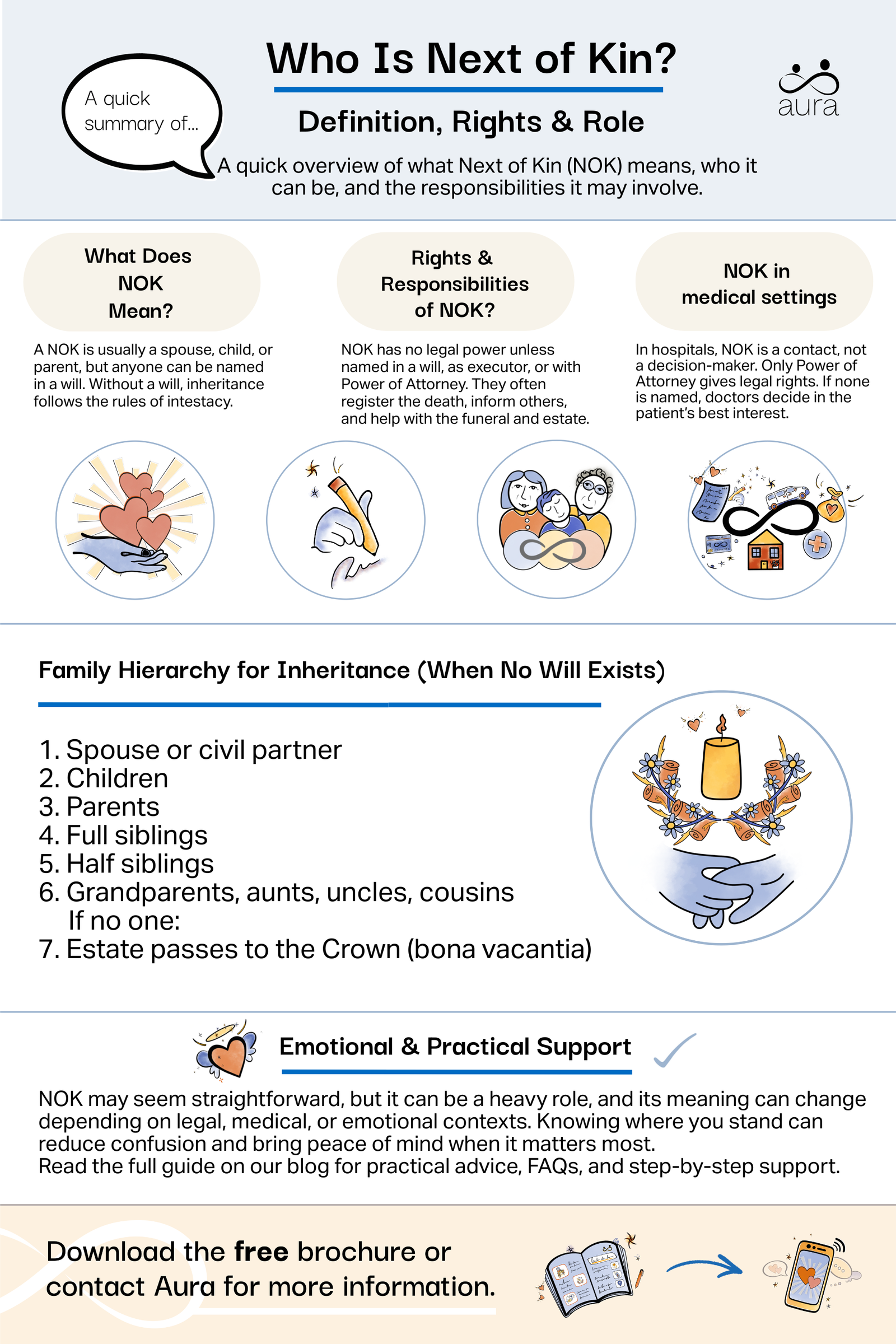
In the UK, “next of kin” isn’t a formal legal status. It’s a commonly used term that typically refers to someone’s closest living relative or chosen contact, but it doesn’t automatically give you legal authority.
What next of kin usually means:
What next of kin doesn’t mean:
If you want someone to have legal authority, you must make it official – by naming them in your will or setting up a lasting power of attorney.
Next of kin can sometimes be named in a medical setting, but it’s important to understand what that really means. Hospitals often ask for a next of kin so they have someone to update or speak to about their loved one’s condition. This person might also help the team understand the patient’s wishes, but they have no legal right to make decisions about care unless they hold Lasting Power of Attorney for Health and Welfare (LPA) —a legal document that gives someone the authority to make medical and personal care decisions on another person’s behalf if they’re no longer able to do so themselves.
If no next of kin is named, that’s also fine. Hospitals are not legally required to have one and will still act in the person’s best interests using clinical judgement and, where possible, the views of those close to the person.
It’s also worth knowing that being named as a next of kin in this way does not give someone the right to inherit anything from the person. That’s an entirely separate process handled by the rules of a will or intestacy.
There is no single legal definition of ‘next of kin’ in the UK that applies in every situation. However, when establishing someone’s closest relatives, particularly when a person dies without a will, there is a legal order of priority.
A simplified next of kin order is:
The exact hierarchy can depend on the circumstances, and relatives further down the list may only be considered if there is nobody in a higher category who is entitled.
It is also important to know that an unmarried partner is not automatically included in the inheritance hierarchy, regardless of how long the couple has been together. Stepchildren are not automatically included either, unless they have been legally adopted by the person who has died.
If someone dies without a will, this is known as dying intestate, and their estate is distributed according to the relevant intestacy rules. If no entitled relatives can be found, the estate may eventually pass to the Crown as bona vacantia.
Your next of kin does not necessarily have to be a blood relative. Depending on the situation, you can name someone you trust, such as your husband, wife, civil partner, parent, child, unmarried partner or close friend.
There is no general legal process for choosing a next of kin in the UK. You may simply be asked to provide their details, for example on hospital, workplace or housing records. However, naming someone as your next of kin does not automatically give them the legal authority to make financial or medical decisions for you.
If you want someone you trust to make certain decisions on your behalf if you lose mental capacity, you may need to set up a power of attorney. The rules and terminology differ across the UK, so it is important to check what applies where you live.
Yes. A close friend can be named as your next of kin for purposes such as being an emergency contact. This can be particularly helpful if you do not have close family members or would prefer someone else to be contacted.
However, being named as next of kin does not automatically give your friend legal rights over your finances, medical care or estate.
A husband, wife or civil partner is commonly considered a person’s closest next of kin, but the term does not have one legal definition that applies in every situation.
Marriage or civil partnership does give someone important legal rights in certain circumstances, including inheritance rights if their partner dies without a will. These rights come from their legal status as a spouse or civil partner, rather than simply from being described as next of kin.
An unmarried partner can be named as your next of kin for purposes such as emergency contact details. However, being in a long-term relationship does not automatically give them the same legal rights as a husband, wife or civil partner.
For example, an unmarried partner does not automatically inherit under the intestacy rules if you die without a valid will. If you want your partner to inherit from your estate or have legal authority to make certain decisions for you, it is important to put the appropriate legal arrangements in place.
If you want to change your next of kin, there is no single central record you need to update. Instead, you should contact each organisation that holds your next-of-kin or emergency contact details and ask them to update their records.
This might include:
You will usually need to provide the person’s name, contact details and their relationship to you. In some circumstances, particularly after someone has died, an organisation may also ask for documents such as photo ID or a birth or marriage certificate to establish your identity or relationship.
When reviewing your arrangements, it can help to check:

To help provide support when you feel ready, we have outlined the rights and responsibilities you have so that you can refer back to them as and when you need to:
The next of kin is not a legally defined term in the UK and as such does not automatically grant you legal rights, powers, or responsibilities. One of the confusing aspects of the term is that it has evolved over centuries to have a variety of different yet partially overlapping meanings.
The original meaning was simply the closest living relative. Understandably, this would be the person who was typically consulted regarding medical decisions. They would know the person in question and be able to inform doctors of their wishes if they were unable to speak on their own.
Inheritance rights will be dictated by who is named as the next of kin in the will, or by the rules of intestacy if no will is left. The next of kin in the will can be anyone the person who has died chooses and therefore may not be the person a doctor would view as closest to their patient. Lasting power of attorney, or a parent or guardian if the person in question is a child, will also trump the next of kin. We understand that this may be complicated and confusing at a time when you simply want to take care of a loved one.
Medical settings will typically require someone close to the loved one whom the doctors and nurses can liaise with. They are not making decisions, but rather serving as a point of contact and a sounding board so that the medical professionals can understand what the patient’s wishes may be.
Although the next of kin will be consulted, this is not the same as them being able to determine the course of action that will be taken. For this to happen, the next of kin will also need to have lasting power of attorney — a designated legal status that gives them a clear set of rights and responsibilities.
When a loved one dies, the next of kin will typically be responsible for registering a death and obtaining the death certification from a doctor. Doing so may require you to familiarise yourself with 2024 changes to death registration in the UK. It’s important to note that a death generally needs to be registered at the registrar’s office within 5 days in the UK, and 8 days in Scotland.
The next of kin will also take on responsibility for informing family friends, employers, and others who need to be made aware. One case that is easy to overlook given the circumstances is to notify banks and building societies of the death. If you are faced with having to do this but are not sure why it is important, we have created a short guide on what happens to bank accounts when you die that may prove useful at this time. The government’s Tell Us Once service can also help reduce the administrative load at what is already a difficult time, especially when dealing with the person’s estate.
While being next of kin doesn’t automatically make you legally responsible for organising the funeral, in many cases, the next of kin does end up going through a funeral arrangements checklist and handling the estate. The estate, in particular, may prove time-consuming or feel challenging when you want to focus on processing your loss and dealing with the unexpected death of a loved one.
Breaking it up into smaller steps may help support you:
A will names the next of kin and can greatly reduce the pressure and uncertainty experienced by those left behind after the death of a loved one. However, if there is a death without a will, the laws of intestacy determine who is the next of kin for inheritance purposes.
Here is a comprehensive outline of the hierarchy involved, starting at the top:
In the unfortunate event that no surviving relatives are identified and found, the estate passes to the Crown and no one will inherit what the loved one has left behind. While the Crown will execute the will, they are not typically regarded as the next of kin and the law will consider no next of kin as having been found. This highlights an important distinction between the next of kin and the executor of a will.
The executor is the person named in the will and has legal authority to handle the affairs of the person who has died. They are legally responsible for carrying out their wishes in a timely manner. Although the next of kin will traditionally organise and oversee the funeral arrangements, they have no legal authority over how the estate is managed unless stated otherwise in the will. It may also be useful to know that to legally act as an executor of a will, you have to apply for letters of probate before you can begin work.
The next of kin plays an important role in terms of inheritance, settling the finances of the estate, and communicating with medical professionals. Although it is a role that has several meanings and no clear legal definition, it is still of paramount importance.
Medical professionals need to identify next of kin so that they can communicate with the family and coordinate care when the patient is unable to speak on their own behalf. Providing updates or changes to their care, arranging times to discharge them, and talking through practical matters are all important.
While the next of kin does not automatically have decision-making powers, many choose to apply for lasting power of attorney when a loved one is unable to care for themselves. This can prove particularly important in cases where end-of-life care decisions need to be made during what can be lengthy and emotionally challenging discussions with medical professionals.
In the absence of a will, it’s general practice for the next of kin to apply to become the administrator of the estate. This allows them to handle probate and redistribute the money and valuables that form the estate. The next of kin may also find that they naturally become the point of contact for banks, government departments, and other organisations and institutions who need to be contacted after the death of a loved one.
While a death in the family can be a challenging and upsetting time, failing to identify the next of kin can cause significant delays to probate and inheritance claims. Identifying the next of kin and then taking the appropriate legal steps that allow them to act may feel at odds with the grieving process for some, but it is also an important part of settling affairs and potentially achieving some degree or form of closure. During this time, questions like “how much does a funeral cost?” often arise—adding financial pressure to an already potentially emotional period, especially when no arrangements were made in advance.
We all grieve in our own way and it is natural for emotions to come out in different ways when a loved one dies. This is one of the reasons why many professionals will say that everyone should be aware of the importance of writing a will while they are still of sound mind.
Keeping everyone up to date and informed can be challenging at the best of times, and more so when you are dealing with your own grief. While a will never makes things easy, it can help to avoid some of those potentially awkward or difficult conversations that may naturally occur when the person’s wishes aren’t clearly known.
We may have covered these points in passing already, but because of their importance, we wish to highlight them here for clarity:
Being the next of kin may feel like an extra weight of responsibility at what is already a difficult time. For this reason, you may find it helpful to make use of the Sue Ryder grief support service or to potentially consider applying for compassionate funeral leave if you are facing difficulty at work.
Others find that understanding end-of-life stages before their loved one dies can help manage the stress of being the next of kin. You may also find that thinking through how you will go about announcing a death to friends can help you come to terms with your loss and reflect on what your loved one meant to you.
Finding ways to work through your grief and come to terms with the fact that a loved one has died is a deeply personal journey. We all do it in our own way — some preferring to stay busy, others prioritising time out — and there is no right or wrong way to do it.
As a family-run funeral provider with a passion for making a difference, we know from experience that being open and accommodating at all times can make a difference. We are always here to discuss prepaid funeral plans if you are making plans for your own future, as well as direct cremation for a loved one who has recently died.
Our approach is always to provide you with options that you can then tailor and personalise so that they reflect what you want. We’re also always available to provide support and hope that this guide plays its own small part in helping you through what may be a difficult time in your life.


If you have any questions, would like a brochure or simply would like a chat through our services, our award-winning team is here to help.
Unlike other providers, we won’t hassle you with constant calls. We’ll simply ensure you have the information you need and leave you to come to a decision in your own time. When you’re ready for us, our team will be ready to help.
Our team is available Monday–Friday, 9.00–5.00pm.
One of the main causes of stress or confusion around the issue of the next of kin is that there is no strict legal definition. Generally speaking, ‘next of kin’ refers to the closest surviving relative of the loved one in question. This could be the spouse or their civil partner, a parent, or an adult child. There is also the option for your loved one to name anyone else they wish as their next of kin, even if they are not a blood relative.
Because there is no strict legal definition in the UK, being named the next of kin does not automatically confer legal powers of decision-making. This requires additional steps, such as applying for and being granted power of attorney.
If the next of kin is named as such in the will of the person who has died, they will inherit the estate as outlined in the will. However, if there is no will at the time of death, the rules of intestacy take over and determine who will inherit the estate. In this case, the next of kin will not automatically inherit the estate, and the estate may be divided up between multiple family members according to how ‘close’ they are in relation to the person who has died.
Proof of a legal relationship with the person who has died will typically be required to fully establish next of kin status. Examples of documentation that may be used to achieve this are birth certificates, adoption papers, and marriage certificates. However, if you are named in your loved one’s will as the next of kin, no other form of proof is required, and you will automatically be granted next of kin status.
A common-law partner is an everyday term for a couple that lives together, but it is not something that is recognised by the British legal system. If the common-law partner is not listed as the next of kin in the dead person’s will, they may find that they do not have the rights to inheritance or the level of legal authority that they expect. In some cases, this may lead to stressful and time-consuming disputes with the blood relatives of their loved one.
In the absence of a lasting power of attorney, trained health professionals will make medical decisions on behalf of someone who is of reduced mental capacity. A key part of their decision-making process will involve consultations with the family so that they can gain a clearer understanding of the wishes of the person they are treating. In the event that no one is willing or able to speak on behalf of the person being treated, the court may decide to appoint a deputy who will speak on their behalf.
One of the difficult things to consider when speaking about next of kin status is that there are several different contexts in which it may mean different things. One such example is within the context of intestacy, in which, by definition, the next of kin is the person who is legally entitled to inherit when there is no will.
By means of example, this is different from the next of kin who would be nominated to speak on behalf of someone of reduced mental capacity within a healthcare setting. This medical definition of the next of kin does not grant any rights of inheritance to the person holding that status.
No, a legally binding will that has been properly executed will, generally speaking, override someone who has been named as the next of kin in another context. The British legal system is set up to recognise the will as the final word of the person who has died about how they want their affairs to be handled and their estate redistributed.
There are cases where no one can be found who would be a suitable next of kin. In these instances, the estate of the person who has died follows a process of bona vacantia — Latin for “vacant goods” — that acts to return the estate to the Crown. The Treasury Solicitor will then act on the Crown’s behalf and will set about administering the estate in line with legal precedent.