×

Two Together: Save £100!Save £100 when you purchase two funeral plans together. Call us for more details.

Written by Emily Cross.
15 minute read

A celebrity funeral is the funeral or memorial service of a public figure, such as a musician, actor, royal, sportsperson, politician or other widely recognised individual. While they range from state funerals watched by billions to private direct cremations attended by just a handful of family members, all celebrity funerals share one quality: they take place at the intersection of private grief and public mourning.
When a public figure dies, it’s not unusual to feel a sense of loss, even if you never knew them personally. Through music, film, television or sport, they can become part of our lives and memories. Their funeral may prompt reflection on our own experiences of grief or remind us of someone we love who has died.
This guide explores some of the most iconic celebrity funerals, particularly in the UK, explains the different forms they can take, and considers what they can teach us about remembrance, legacy and planning our own farewells.
Key takeaways:

Celebrity funerals are known for attracting a high degree of public attention because millions of us feel an attachment or sense of connection with the celebrity who has died. Public figures and celebrities we have followed for many years may have provided a sense of permanence in our lives, resulting in a real sense of loss when they die. Many people choose to pay their respects by watching parts of the funeral on television or, where they can, by gathering along the procession route.
It is not uncommon for celebrity funerals to become times of collective mourning where large swathes of society come together to share thoughts, feelings, and an overarching sentiment.
The funeral of Princess Diana is perhaps the most notable in living memory for many of us, while previous generations may have felt the same about the state funeral of Winston Churchill. They both become collective moments in the nation’s history in which millions of people from many different walks of life found themselves thinking and reflecting on a common set of feelings and emotions.
The rapid expansion of 24/7 media coverage and social media has given the British public more access than at any point in the nation’s history. Being able to share online tributes, view many major events in real time, and exchange memories, thoughts, and ideas with people across the country with the click of a button has intensified the public mourning and grieving process in many ways.
Celebrity funerals in the UK generally fall into three categories: state funerals, royal ceremonial funerals and private funerals. The type of funeral depends on the person’s public role, their family’s wishes and, in the case of a state funeral, a formal decision by the Crown.
State funerals are the UK’s highest funeral honour. They are usually reserved for serving monarchs and, on rare occasions, people who have made an exceptional contribution to public life. They often include lying in state, a ceremonial procession and a service at Westminster Abbey or St Paul’s Cathedral. Queen Elizabeth II’s state funeral in 2022 is widely regarded as the most-watched funeral in history.
Royal ceremonial funerals are similar in scale and tradition to state funerals but have a different legal status. One of the best-known examples is the funeral of Diana, Princess of Wales, in 1997, which included a procession through London and a service at Westminster Abbey. Other examples include Queen Elizabeth The Queen Mother and Prince Philip.
Many celebrities choose private funerals attended only by family and close friends. David Bowie famously chose a private cremation with no public ceremony, while Cilla Black and Lynsey de Paul also had private farewells. Some families later hold a public memorial, while others keep the funeral entirely private. Increasingly, well-known figures are choosing simple options such as direct cremation, showing that a meaningful farewell doesn’t have to be a public event.
From state funerals at Westminster Abbey to private cremations, the UK has been the setting for some of the most memorable celebrity funerals of recent decades. These examples show that there is no single way to say goodbye, even for people in the public eye.
Queen Elizabeth II received a state funeral following four days of lying in state at Westminster Hall. Her funeral at Westminster Abbey was watched around the world before a committal service at St George’s Chapel, Windsor. It remains one of the most-watched events in television history.
Diana’s royal ceremonial funeral brought millions together in mourning. The procession from Kensington Palace to Westminster Abbey, Elton John’s performance of Candle in the Wind 1997 and Earl Spencer’s eulogy made it one of the most memorable public farewells in modern history.
Prince Philip’s funeral was scaled back because of COVID-19 restrictions, with just 30 guests attending St George’s Chapel. One of its most personal touches was the bespoke Land Rover hearse that he helped design himself.
Churchill was one of the few non-royal figures to receive a state funeral. After lying in state at Westminster Hall, his funeral was held at St Paul’s Cathedral before his coffin travelled along the River Thames in a nationally significant farewell.
Despite his global fame, Freddie Mercury’s funeral was a private Zoroastrian service attended by around 35 family members and friends. His ashes were kept in a private location, reflecting his wish for a personal farewell.
David Bowie chose a private direct cremation with no public funeral or memorial service. His decision reflected his wish for “no fuss” and helped raise awareness of direct cremation as a simple, personal choice.
Cilla Black’s funeral at Liverpool’s Cathedral Church of St Mary combined private faith with public affection. Family, friends and well-known figures gathered to celebrate her life in the city she loved.
Margaret Thatcher received a ceremonial funeral with military honours at St Paul’s Cathedral. While not a state funeral, it reflected her significance as a former Prime Minister and prompted national reflection on her legacy.
Other well-known figures who chose private farewells include George Michael, Bruce Forsyth and Sir Sean Connery. Their funerals demonstrate that even globally recognised people often prefer intimate funerals centred on family and close friends.
Beyond the UK, several international celebrity funerals have shaped how famous lives are remembered. They show that, regardless of culture or location, personal wishes often sit alongside public remembrance.
Michael Jackson’s public memorial at the Staples Center in Los Angeles was watched by an estimated one billion people worldwide. His later burial at Forest Lawn Memorial Park reflected the contrast between a global tribute and a private family farewell.
Whitney Houston’s funeral took place at the church where she first sang as a child. The service featured tributes from family, friends and fellow musicians, showing how a meaningful location can make a farewell even more personal.
Steve Irwin was remembered with a public memorial at Australia Zoo, where he had devoted much of his life to wildlife conservation. The venue reflected his lifelong passion and connection to the place.
Paul Walker’s family held a private funeral before fans organised memorial events celebrating his love of cars. His farewell balanced private grief with public remembrance.
Writer Hunter S. Thompson’s ashes were famously fired from a cannon, fulfilling his final wishes. His highly personalised farewell remains one of the most unusual celebrity funerals, highlighting how a funeral can reflect a person’s character and values.
Direct cremation is a simple cremation without a funeral service beforehand. Once considered unusual for public figures, it has become an increasingly popular choice for people who value privacy, simplicity and flexibility, and is now one of the best-known funeral alternatives to a traditional attended funeral.
David Bowie chose a private direct cremation with no public ceremony, reflecting his wish for a simple farewell. His decision helped raise awareness of direct cremation as a dignified alternative to a traditional funeral.
Other public figures, including Sir Sean Connery, also chose private cremation, with their families holding personal commemorations separately. As individual arrangements are not always made public, it’s important to verify details before drawing comparisons.
For many, the appeal is its simplicity and privacy. Direct cremation allows families to hold a memorial at a time and place that feels right for them, without the pressure of organising a public funeral immediately after a death.
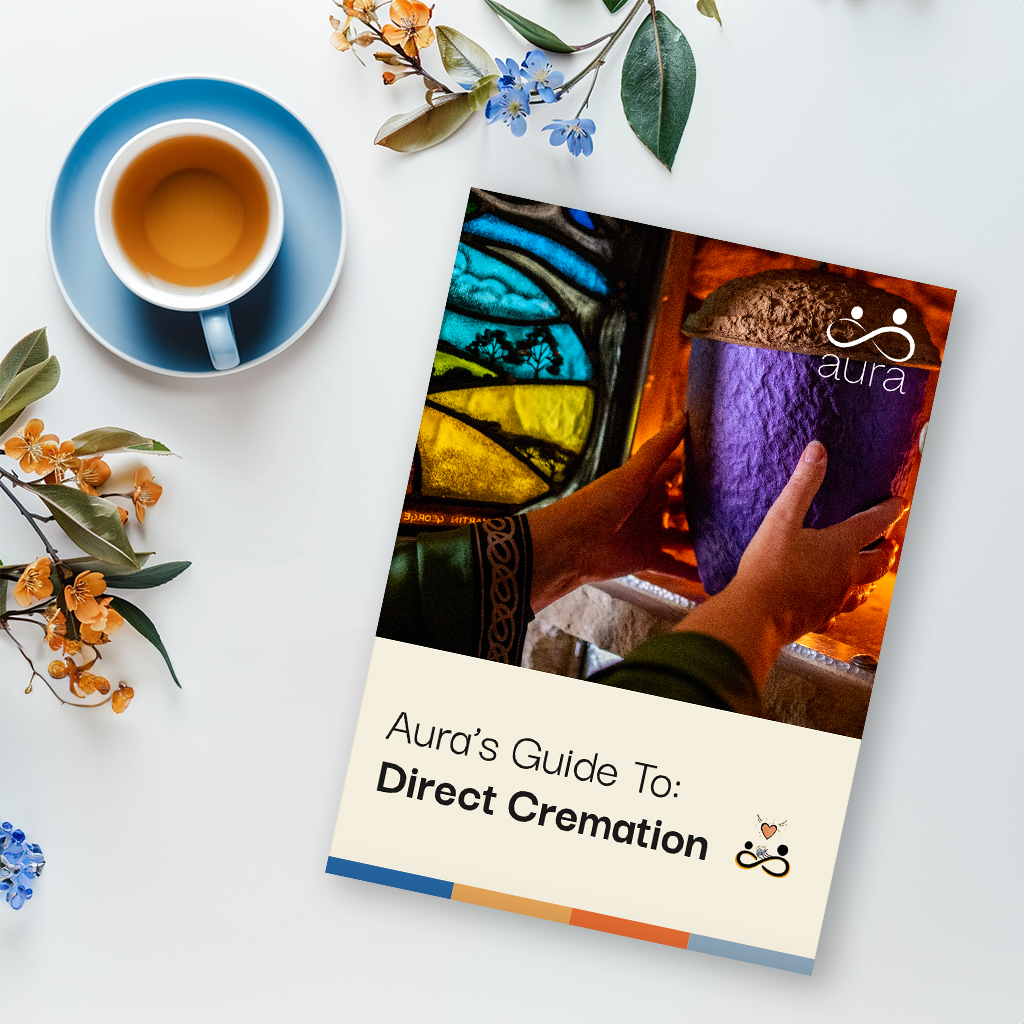
If you’d like more information about direct cremation and Aura’s funeral plans, then our downloadable guide can help. Find out why others are choosing this affordable, no-fuss alternative to traditional funerals and why it might be right for you too.
Download our guide by clicking the link below and learn more about this simple funeral plan option.
A growing number of public figures have chosen funerals that reflect their environmental values. From alternative cremation methods to natural burials, these choices have helped raise awareness of more sustainable funeral options.
Archbishop Desmond Tutu chose resomation, also known as alkaline hydrolysis or water cremation. This alternative to flame cremation uses water and alkali to return the body to its natural elements and brought international attention to this emerging funeral option.
Actor Luke Perry was buried in a biodegradable Infinity Burial Suit, which uses mushroom spores to support natural decomposition. His family’s decision helped introduce many people to environmentally friendly burial options.
Some public figures have also chosen woodland burials, biodegradable coffins and tree-planting memorials. Others, including David Bowie, opted for direct cremation, which can have a lower environmental impact than a traditional funeral with a hearse, procession and attended service.
Some celebrity funerals are remembered not for their size, but for the personal requests left by the person who died. These unique choices show that a meaningful farewell can reflect someone’s personality, values and wishes.
Writer Hunter S. Thompson asked for his ashes to be fired from a cannon, a request funded by his friend Johnny Depp. While highly unusual, it reflected Thompson’s larger-than-life character and his wish for a farewell that was unmistakably his own.
The creator of The Muppets asked mourners not to wear black at his memorial services. Instead, the focus was on celebrating his life with colour, music and joy, reflecting the creativity and optimism that defined his work.
Many families now personalise funerals with themed dress codes, favourite music or meaningful locations. Others choose environmentally friendly options or hold celebrations of life instead of more traditional services. These choices reflect a growing recognition that there is no single “right” way to say goodbye, only the way that feels most meaningful to the person and those who loved them.
We believe that the role of a family-run funeral provider such as ourselves is to provide guidance, support, and comfort as opposed to focusing purely on planning and making arrangements. In our experience, a listening ear and a kind word can go a long way, and the same is true if you are thinking about how to process your emotions when a public figure you cherish dies.
As part of the act of public mourning, you might begin to reflect on the choices you will have to make if someone you love dies. Should the need arise, we have a guide that will help you to compare funeral plans, a detailed explanation of our cremation services, and up-to-date information regarding practical matters such as direct cremation prices. We share these links only so that you know help is available as and when you may need it.
Princess Diana’s funeral is estimated to have been watched by 2.5 billion people around the world, and that of the late Queen Elizabeth II was watched by as many as 4.1 billion viewers. One of the reasons for this is thought to be the sense of permanence that key figures in national institutions such as the Royal Family provide to everyday people. A period of public mourning and collective loss was experienced in both cases and many people found that speaking openly about how they felt at public memorials, or by leaving written or symbolic tributes, helped them to process their emotions and sense of loss.
A state funeral comprises a military procession, a period of lying in state, and a service that is conducted at Westminster Abbey or St Paul’s Cathedral. Famous figures outside of the line of the monarchy who have received state funerals include Winston Churchill, William Gladstone, Lord Palmerston, Isaac Newton, Lord Nelson, and the Duke of Wellington.
While the public outpouring at the death of Princess Diana is perhaps unrivalled in living memory, a great number of people publicly grieved the deaths of cultural icons Cilla Black and Lynsey de Paul. Lynsey de Paul’s funeral, in particular, was a highly emotional event due to the profound shock that many close to her expressed about her untimely death.
This is a matter for the next of kin, even in the case where the global public profile of a notable person makes everyone feel like they have some form of relationship with them. The case of David Bowie mentioned earlier highlights how global stars and cultural icons still reserve the right for a modest, private final act if they so wish. Others, particularly in the case of those receiving state funerals, will have expressed a wish for highly public occasions that allow millions of others to pay their own tributes.
Although the emotions of many fans and followers may run high at such times, the most important thing to remember is that public figures still have family and close friends. Respecting their wishes will ensure that the right boundaries are kept while they are processing their own grief.
No. Many globally famous people choose private funerals attended only by close family and friends. David Bowie chose a direct cremation with no public service, while Freddie Mercury’s funeral was attended by around 35 people. Like any other family, the family of a public figure has the right to arrange a private farewell, regardless of the person’s fame.
Many celebrities and public figures choose to plan their funerals while they are still alive so that they can create a final act that they feel is befitting of their legacy. In the case of the Prime Minister or a monarch, there are dedicated teams of people whose job it is to have funeral plans in place in what may prove to be decades before they die.
Some celebrities and public figures may also feel that by having a plan in place in advance, they can remove some of the emotional pressure placed on the people they leave behind. A pre-planned public funeral can remove many of the potential disagreements and result in a fitting tribute that matches their achievements, personality, and public perception.
David Bowie is one of the best-known public figures to choose direct cremation. Following his death in 2016, he was cremated in New York without a funeral service, in keeping with his wish for a simple, private farewell. His ashes were later scattered in Bali. Other public figures have also chosen private cremations, showing that even those in the public eye often value simplicity, privacy and giving loved ones the freedom to hold a memorial in their own time.