×

Plan ahead and save up to £200 Save up to £200 on selected funeral plans until 31 October. T&Cs apply. Click here for full details.

Two Together: Save £100!Save £100 when you purchase two funeral plans together. Call us for more details.

Written by Emily Cross.
24 minute read

Article reviewed by Judy Carole, Published Author on May 2, 2025.
When someone you love dies it is understandable to feel overwhelmed by a complex range of emotions. Knowing how to deal with grief may help as it can give you a framework that you can then adapt to your personal situation. Even so, it’s important to be kind and understanding with yourself because how you grieve will be unique, and will shape what you do when someone you love dies.
For some, knowing what to do when someone dies begins with practical steps to settle affairs. For others, grief takes over before anything can be done. You might need to sit with your emotions and reflect for a while — that’s perfectly natural. It’s all part of processing what’s happened.
You will move through grief at your own pace, which might not match others around you, and that’s okay. The commonly known five stages of grief — denial, anger, bargaining, depression, and acceptance — can be a helpful way to understand your feelings. You may not go through them in a straight line, and you might revisit stages more than once. Grief doesn’t follow rules, but having a model to refer to can provide something steady if emotions feel overwhelming.
As a family-run funeral provider, we care about providing support on both a practical and an emotional level. We understand that grief is a deeply personal process and we hope this article offers you some comfort and guidance along the way.
Key takeaways:

Grief is more than sadness. It’s the emotional, physical, mental and behavioural response to losing someone or something important. The five stages of grief are a way of describing some of the most common emotions people experience after a loss. They are not a checklist to complete or a route map that everyone follows. Instead, they offer a shared language for feelings that can often seem confusing, unpredictable and overwhelming.
Having a framework to return to can help you make sense of your experience, even if it doesn’t reflect everything you’re feeling. Some people relate to every stage, while others only identify with one or two, or experience them in a completely different order. There is no right or wrong way to grieve. The five stages are simply one way of understanding a process that is often anything but straightforward.
The Kübler-Ross model originates from the field of bereavement psychology where it was originally formulated to outline the emotional journey experienced by terminally ill patients. Over time it has come to be widely adopted by those processing all manner of different types of loss, not just those faced with their own death. It’s important to note that because it is a model, rather than a definitive theory, it cannot account for the fact that experiences will differ from one person to the next.
No two people will cope with losing a parent, the suicide of a loved one, or the unexpected death of a loved one in exactly the same way, and there is nothing wrong with this. One person may follow each stage in a textbook progression, while someone else may skip a stage and then repeat another multiple times. Both experiences are equally valid and neither means that the model is either exactly right or completely wrong.
The model’s purpose is to show that grief involves different stages…emotional, cognitive, and behavioural. Being aware of this may help you be kinder to yourself. Each stage is a way of coping and moving towards healing.
Grief is the internal emotional experience of loss. Mourning is the outward expression of grief through rituals, behaviours and cultural traditions. Bereavement is the state of having lost someone. In simple terms, a person is bereaved, they feel grief, and they may express it through mourning.
Although these terms are often used interchangeably, they each describe a different part of the experience of losing someone. Understanding the difference can make it easier to talk about loss and recognise what you or someone else may be going through.
Grief is your personal response to losing someone important to you. It can affect your emotions, your body, your thoughts and your behaviour. You might feel sadness, anger, guilt or relief. You may struggle to concentrate, find it difficult to sleep, feel exhausted or notice changes in your appetite. Some days may feel manageable, while others can feel overwhelming.
Everyone experiences grief differently. There is no right or wrong way to grieve, and there is no fixed timeline for when you should start to feel better.
Mourning is how grief is expressed outwardly. This may include attending a funeral, taking part in religious or cultural traditions, wearing certain clothing, gathering with family and friends, or setting aside time to remember the person who has died.
The way people mourn is shaped by their culture, faith, family traditions and personal beliefs. Some people express their grief openly, while others prefer to grieve more privately. Neither approach is more valid than the other.
Bereavement is the fact of having lost someone through death. It describes the situation rather than the emotional response to it.
While bereavement is the event or circumstance, grief and mourning are the ways people respond. Every bereaved person will have their own experience, and there is no single path through loss.
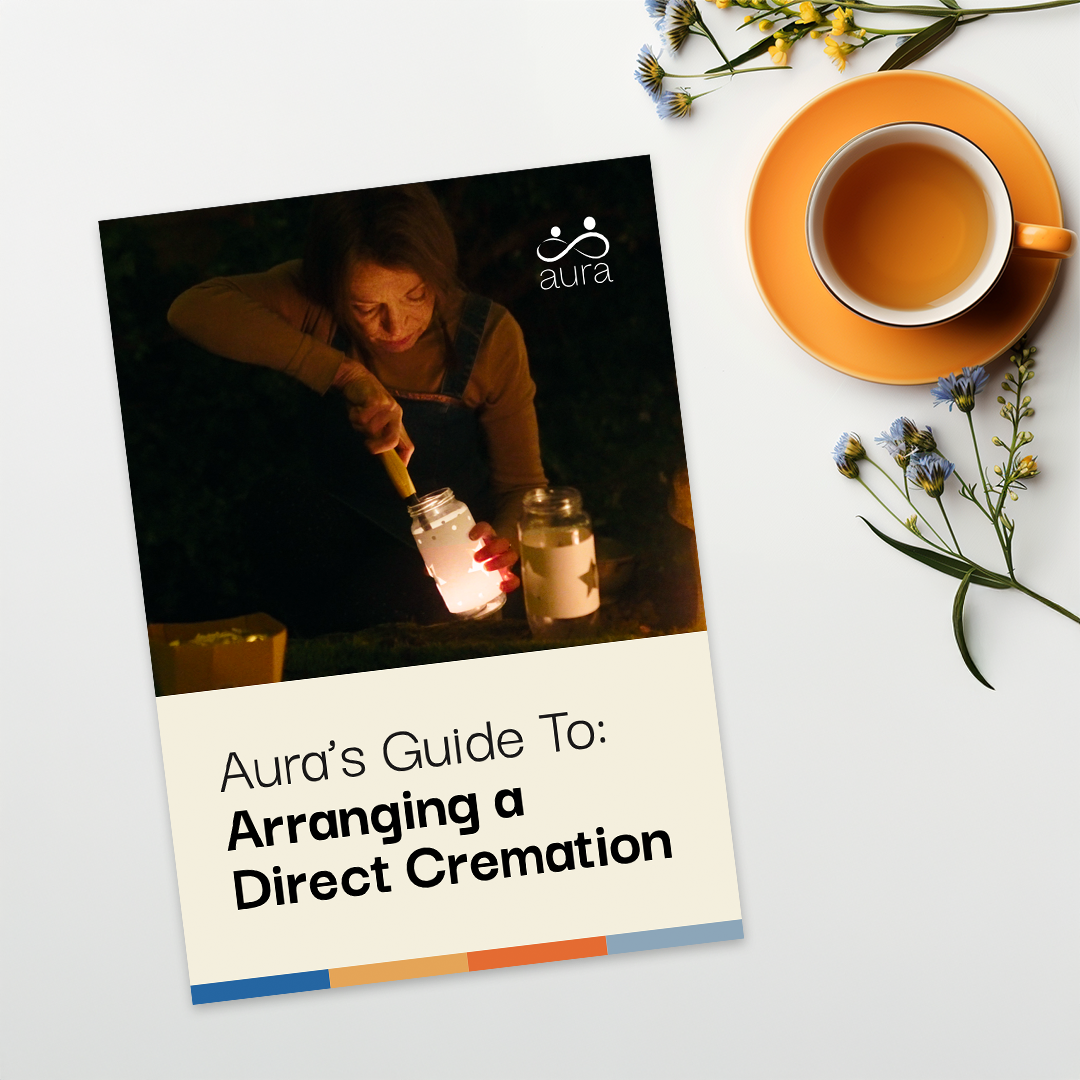
Grief is different for everyone, and there’s no right pace to move through it. What matters is having the support you need when you’re ready. At Aura, we understand how hard it can feel to make funeral arrangements after losing someone you love, which is why our compassionate Aura Angels are here to guide you—one step at a time.
With our simple and dignified direct cremation services, we give families the space to grieve and remember in their own way, without pressure or fuss. Whether you need a listening ear or practical help, we’ll walk beside you, making sure you feel supported and cared for throughout.
If you want to learn more, we’ve created a free guide that talks you through arranging a direct cremation. It’s written in simple, plain-English and gently covers what’s involved and how Aura can help. You can read it in your own time, or share it with family if that feels right. Click the link below to download our guide today.

Denial is when you attempt to tell yourself that nothing has happened and that everything is as it was before your loved one died. It is often the first stage of the grieving process.
The protective shield
Denial is a natural reaction to overwhelming loss or trauma and acts as a form of emotional shield that prevents you from having to immediately face the fact that someone has died. By creating distance between reality and your emotions, denial gives you time to gradually come to terms with what can be a very sudden change.
A common sign of denial would be if you were to continue with your regular routine of going to work, coming home, and laying the table for both of you even though your partner has died. It can act as a buffer between shock and reality, and give you time to adjust, at your own pace.

Anger is a natural coping mechanism that often comes to the surface when you feel you need to blame someone for the death. It is an attempt to rationalise something that may feel cruel and arbitrary.
The search for blame
Anger often masks the pain and vulnerability that are percolating under the surface. Being angry at hospital staff, GPs, or even other loved ones you feel have not shouldered the same pressure is natural.
You should not feel guilty or ashamed for being angry because it is a natural and healthy way to start releasing pent-up emotions. Over time, anger will subside and you will find that you can develop new coping mechanisms.

Bargaining is a natural attempt to try and replay events and change the outcome. Many of us find solace in the belief we could have done things differently and that events were not entirely out of our hands.
The “what if” phase
A period of mental negotiation often occurs in response to grief, and it’s an attempt to see how you could change the outcome. Even though you cannot change the fact someone you love has died, giving some thought to how you would may provide you with a sense of comfort and clarity.
To many, bargaining is about making a concerted effort to regain a sense of control or hope about a situation that is hard to process emotionally. Finding alternative ‘solutions’ can also open your mind to other points of view and could also provide you with new ways of thinking about your situation.

Depression is often thought of as the point at which reality fully kicks in. While we by no means want to paint any of the previous stages as anything like delusion, depression can be when many people describe how they feel as becoming ‘real’ and permanent.
The weight of reality
This stage typically reflects the full emotional impact of loss and it can feel more overwhelming than anything you have been through so far. Some may find this disheartening because it’s easy to think that you ‘should’ feel better with each passing day. In truth, grief is typically a much more complex process.
Depression during the grieving process is different from clinical depression in that it may feel completely absent during certain parts of the day, only to return in full force without warning. Clinical depression tends to be more constant and predictable throughout the course of the day.
If you find that feelings of depression are becoming all-consuming, you may wish to consider contacting your GP. They can then refer you to specialist help in your local area so that you can continue on your healing journey.
Accepting that someone has died isn’t about forgetting them. Acceptance is when you come to terms with death and develop a clear vision for the form you want your life to take from now on.
Finding a way forward
Acceptance means learning to live with the loss, not forgetting it, and certainly not forgetting the person who has died. People experiencing acceptance will typically be calmer and more reflective than those working through some of the earlier stages of the grieving process.
Arriving at a stage of acceptance is about coming to terms with the death you have been processing and figuring out what happens next. Something as simple as trying out a new routine, hobby, or evening activity may help you continue to move forward and develop other healthy habits. This part of your life is about self-care, reflection, and achieving a sense of balance.
The five stages of grief are just one way of understanding loss. Since Elisabeth Kübler-Ross introduced her model in 1969, researchers have developed other frameworks that reflect how personal and varied grief can be. Rather than following a set sequence, these models suggest that grief changes over time and looks different for everyone.
Developed by Margaret Stroebe and Henk Schut, The Dual Process Model suggests that people naturally move between focusing on their grief and adjusting to everyday life. Both are important parts of coping with loss.
Counsellor Lois Tonkin’s Growing Around Grief model suggests that grief doesn’t necessarily become smaller. Instead, your life gradually grows around it, so while the loss remains, it becomes easier to carry alongside new experiences and relationships.
Psychologist J. William Worden viewed grief as an active process. His framework focuses on accepting the loss, working through painful emotions, adapting to life without the person who has died, and finding an enduring connection with them.
Developed by Dennis Klass and colleagues, The Continuing Bonds theory suggests that maintaining a connection with the person who has died through memories, traditions or personal rituals can be a healthy part of grief, rather than something that needs to be left behind.
No single model explains everyone’s experience. These frameworks are simply different ways of understanding grief and reminding us that there is no right or wrong way to grieve.
Anyone who is remembering a loved one may find that they ‘regress’ if they attempt to stick rigidly to the model. In this context, ‘regression’ doesn’t mean a backward step, rather, it means that grief is non-linear in many cases. Going back a step to then move forward is a sign that you are healing and continuing on your own personal journey. Many experience regression when something triggers them, such as the first birthday after the death of a loved one, or a holiday commonly shared with family, and this is completely normal.
Repeating and skipping particular stages is something that many people report and is not a sign that you are somehow not coping or not healing emotionally. The nature and timeframe of the grieving process are completely unique to you. If you find that someone else appears to be coming to terms with a death and functioning far quicker again, while this may be disheartening, it is by no means a sign of failure. You will get there in your own time.
Even though it may not feel like it right now, there are ways to cope with grief and places you can go for emotional support at this difficult time.
While we never want to prescribe what you should do, you may find it helpful to consider a few of the following options:
If you are one of the first to find out about the death of someone you love, you may find that choosing to tell others can help you process how you feel. Our guide on how to break bad news may help you find the right timing and choice of words in this case.
Grieving is natural, but sometimes, the pain doesn’t soften with time. In some cases, it can become something called complicated grief — also known as prolonged grief disorder. This is when intense and persistent feelings of loss continue for over a year, deeply affecting daily life. It can feel impossible to accept what’s happened or to find a way back to living normally.
If you’re finding that your grief feels overwhelming or never-ending, you’re not alone, and you don’t have to face it without help. Professional support can offer comfort, understanding, and the right tools to help you heal at your own pace.
Seeking help is a sign of strength and self-compassion, not weakness, and you may find that your local GP is the first port of call. They will be able to redirect you to counselling services and therapists active in your local community.
When you’re navigating loss, sometimes a small, practical step can bring a sense of ease and comfort. Even putting one or two things in place can help lighten the weight you’re carrying, especially when there’s guidance available to make things simpler.
If you feel ready to organise a cremation service, Aura is here to help. We offer both attended and unattended direct cremation services starting at £1,295. If you’d like to understand more about our pricing and what we provide, we can offer a free, personalised quote over the phone or online, whichever feels easier for you. Our quote comes with no pressure or obligation, just answers to your questions so you can decide what feels right for you and your family

The Kübler-Ross model was developed in a Western, secular and clinical context. Grief, however, is shaped by culture, religion, family traditions and community. The five stages may resonate with some people but not with others.
Different cultures express grief in different ways. Some encourage open displays of emotion and communal mourning, while others place greater emphasis on private reflection. Religious beliefs also shape how people respond to loss. For example, Jewish families may observe shiva, while Hindu, Sikh, Christian, Muslim and many other faiths have their own traditions that offer comfort, meaning and support.
In Mexico, Día de los Muertos celebrates remembrance and continuing connection with loved ones who have died. Many cultures also view grief as something shared by family and community, rather than carried alone. This understanding has influenced modern grief theories, including the Continuing Bonds framework, which recognises that maintaining a connection with the person who has died can be a healthy part of grieving.
Loss isn’t always about death, although we fully accept that the loss of life can feel like the greatest loss of all. If you have come to miss something in your life, but not through the death of a loved one, you may find the following section helpful.
Divorce, loss of employment, terminal illness, or major life changes like being forced to move or relocate can all trigger a sense of loss. Some will be greater and more acute than others, but they all remain equally valid. The interesting thing is that, for many of us, each of these sources of grief will follow a similar model as the one relating to death this article has focused on. With this in mind, you may find that the model serves as a useful point of reference when you want to create your own coping strategies.
Some people also find symbols of grief meaningful — objects or gestures that help express and process loss. This could be something you find comfort in as you adapt to a new chapter.
No matter how you choose to use our services, or what you choose to do with our many online resources, we are always right here when you need us. Death and the grief that follows is a deeply personal journey that you will work through in your own way and at your pace, and we completely understand that.
Aura is a family-run funeral service built on care and compassion. Our goal is to always serve families with kindness and to take some of the weight of funeral arrangements from your shoulders, so you can focus on your own grief, your memories, and your loved ones.
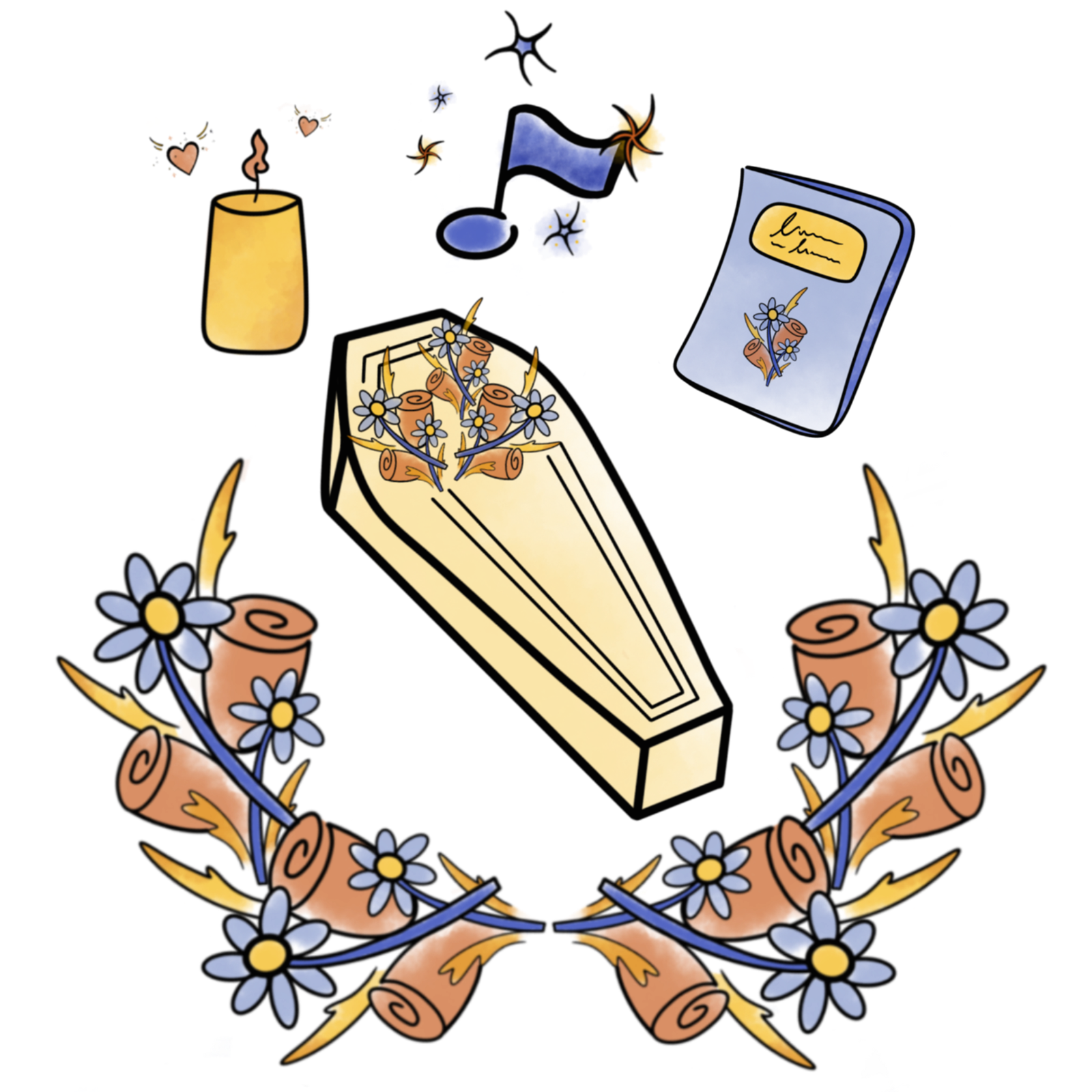
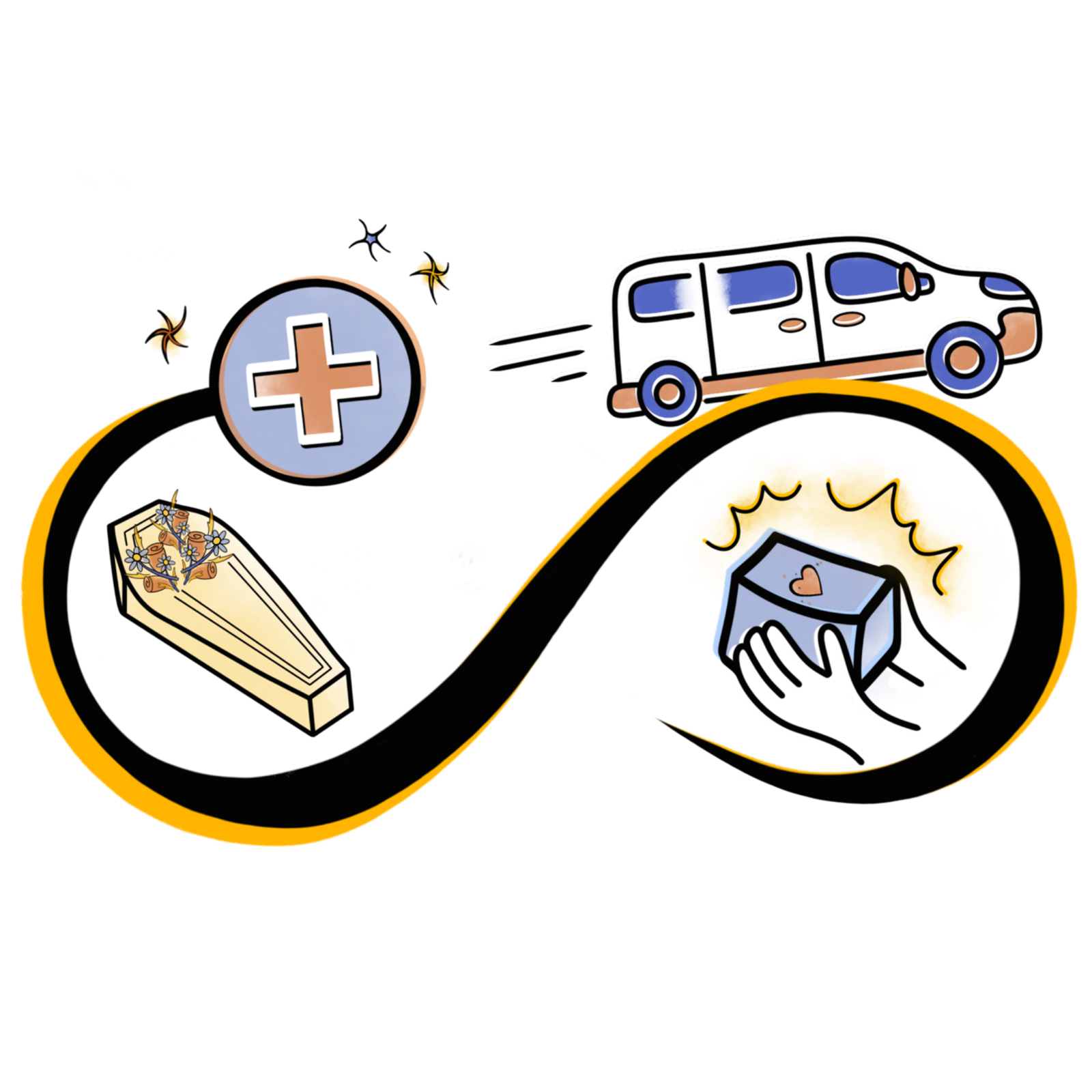
If someone you know has passed away or is expected to pass away soon, we are here to help with our direct cremation services. Our team will care of the practical details with sensitivity and respect, so you have one less thing to carry during this time.
For those who are thinking ahead, our prepaid funeral plans provide a way to ease future burdens. By making arrangements in advance, you can help protect your loved ones from difficult decisions and unexpected costs when the time comes.
No matter where you are on this journey, we are here to help you. Whether you use our services or take a look at our online resources, we are here when you need us. Death and the grief that follows is a deeply personal journey that you will work through in your own way and at your pace, and we completely understand that.


Elisabeth Kübler-Ross created a 5-stage model that includes denial, anger, bargaining, depression, and acceptance. While some contend that the model is not scientifically proven, it may prove to be a useful tool for those looking to understand how they are feeling at a given moment in time.
Having a model to refer back to that is based on observations of lived experiences could help you anchor yourself to a process. Others may find that it provides a sense of clarity, perhaps even closure, because it shows that grief may not last forever in its current form. Having some awareness that the way you feel now will change as you move forward could help you carry the emotional weight a death in the family can create.
One of the potential issues with referencing a model for grief is that it may create unrealistic expectations. Different resources that discuss the model may attribute different timescales to the various stages, for example, some will say that depression typically lasts much longer than denial. While statements like this may be true for many people, they will be at odds with the experiences of others. For this reason, we prefer not to offer typical time frames for each of the five stages.
Instead of focusing on timeframes, you may wish to consider that grief itself is not a linear process that takes you from one stage to the next. You may find you occupy multiple stages at the same time, or you may find that you move backward to a previous stage. This is not a sign of failure, but simply a demonstration of the fact that grief is a highly complex, personal process. Using the model as a reference and a starting point, but not a rigid set of expectations, may allow you to strike the right balance.
Yes, many people find that they skip particular stages of grief, while others find they repeat certain stages several times. Neither is right or wrong because grief itself is so complex and personal that it is simply not possible to create a universal model that applies in every single case.
There is no right or wrong way to cope with grief, only different ways. Some people find focusing on their physical health and well-being with exercise and diet helps. Others may prefer to have time alone to reflect or to talk to someone close to them who knew the person who has died. There are also many combinations of these different coping mechanisms, and they can also change over time. Being kind to yourself and remembering that you have the right to cope with grief however you wish may also help you maintain perspective.
Bereavement is the state of having lost someone through death, while grief is your emotional, physical and psychological response to that loss. Mourning is how grief is expressed outwardly, whether through personal rituals, cultural traditions or religious practices. In simple terms, a person is bereaved, they feel grief, and they may express it through mourning.
Prolonged grief disorder (PGD) is a recognised mental health condition where intense grief continues for many months and significantly affects everyday life. People with PGD may find it difficult to accept the death, experience persistent longing for the person who has died, or struggle to return to work, relationships or daily routines.
Not always, although starting with the model outlined in this guide may provide you with insights into how you feel. Some people skip a stage, others repeat a stage. Using the model to increase your awareness of how you may feel in the near future is helpful, but sticking to it rigidly and then being unkind to yourself when you deviate from it may not be. Grief is a personal journey that you have to experience and work through at your own pace and in your own way.
Yes, many people report repeating certain stages of grief, some multiple times. Be kind and understanding to yourself, and try to avoid direct comparisons with those around you, and you will be able to find your own path through grief so that you can continue with life.
Different people will require different things, but there are some general principles that you may find helpful to consider. In the majority of cases, the person you are helping will not want you to try and ‘fix’ or ‘solve’ their grief for them — it is something they have to work through and it is as real as the fact that someone they love has died.
Common ways that you can help include validating their feelings, being present and attentive, listening to what they say, and creating a safe space where they can talk and be themselves. Depending on your relationship with the person who is grieving, they may wish to use their time with you as a distraction from the grieving process. This is perfectly natural and something that can go a long way to helping them lift their emotional energy at a difficult time.
It’s a model, not a definitive theory or a rigid timeline that everyone follows. Lived experiences differ from one person to the next, but the idea of a model may help many reading this guide to gain clarity about what they are feeling and experiencing. Some choose to dismiss the model, others find it helpful to study it in more detail. The right approach is whatever feels like it is helping you at any given moment in time.
Your grief may not look anything like the five stages, and that’s completely normal. The Kübler-Ross model is one way of understanding grief, not a set of stages that everyone goes through. Some people never feel denial or anger, while others experience emotions such as guilt, relief or numbness instead. Grief can also be shaped by your culture, faith, family traditions and relationship with the person who has died.
If your experience doesn’t fit the model, it doesn’t mean there’s anything wrong with you. It simply means the model doesn’t fully reflect your grief. There is no right or wrong way to grieve, and no timeline you have to follow.