×

Two Together: Save £100!Save £100 when you purchase two funeral plans together. Call us for more details.

Written by Emily Cross.
18 minute read

Knowing how to announce a death can be difficult, especially when you’re grieving someone you love. It’s often best to tell close family and friends in person or over the phone before sharing the news more widely through a message, death announcement or social media. There’s no single right way to do this, but sharing the news gently and clearly can help make a difficult conversation a little easier.
When someone close to you dies, finding the right words can feel overwhelming. You may be coming to terms with the loss yourself while worrying about how others will react. It’s important to remember that you don’t have to tell everyone at once, and it’s okay to ask someone you trust to help.
There are different ways to announce the death of a loved one, depending on who you’re telling and what feels most comfortable. You might prefer a personal conversation with close relatives, a thoughtful message to friends or a written announcement to let others know.
In this guide, we’ll explain how to announce a death to family and friends, what to say and how to write a death announcement. We’ll also share examples and practical advice to help you find the words when they’re hard to come by.
As a family-run provider of direct cremation services, we understand how personal and emotional this time can be. We hope this guide offers some reassurance as you share the news with the people who knew and cared for your loved one.
Key takeaways:

A death announcement is typically a short notice of just a few lines of text that is sent to relatives, friends, and wider acquaintances within 24 hours of the death. It differs from an obituary, which is typically longer, includes context about the person’s life, and is often published in public forums such as newspapers and online noticeboards. The idea of an obituary is to begin commemorating the life of the person who has died, whereas the death announcement is more focused on informing people of the death for the first time.
While we have the right to announce the death of someone close to us, it is typically left to the next of kin to make the announcement first. Doing so in a way that combines clarity and respect is important, as reading the announcement will often be the way that many people who knew the person learn of their death.
As such, the death announcement will typically include the name, age, and place of death. If the death announcement is posted online, you may wish to edit it at a later date to include details of the funeral announcement once the arrangements have been made.
In the following sections we will provide guidance and advice we think you may find helpful. We have also created a guide that covers how to announce a death to friends if you would like some input regarding timings and the choice of words to use.
Telling someone that a person they love has died can be one of the hardest conversations you’ll ever have. You might be worried about finding the right words or how they’ll react, especially if the death was sudden or unexpected.
Where possible, it’s often best to tell close family members and friends in person or over the phone. This gives you the chance to speak gently, answer any immediate questions and offer comfort.
You don’t need to prepare a long explanation or find the perfect words. A few simple, honest sentences are often enough. You could say:
Try to use clear, gentle language, including the words “died” or “has died”. Although phrases like “passed away” or “we’ve lost them” may feel softer, they can sometimes cause confusion, particularly when someone is hearing the news for the first time.
Once you’ve shared the news, give the person time to take it in. They might cry, become quiet, ask questions or struggle to believe what they’ve heard. There’s no right or wrong way to react.
If you’re unsure how to approach the conversation, these simple steps may help:
You also don’t need to have the funeral arrangements worked out before sharing the news. It’s perfectly fine to say, “We haven’t made any arrangements yet, but we’ll let you know when we have more information.” Above all, remember that you don’t have to get everything right. Speaking with kindness, honesty and care is what matters most.
Finding the right words to announce someone’s death isn’t easy, especially when you’re grieving yourself. Whether you’re sending a text, writing an email or sharing the news with a group, a simple and thoughtful message is often all you need.
The examples below can be adapted to suit your circumstances. You don’t have to include every detail, and it’s okay to let people know that you’ll share more information when you’re ready.
A text message can be a gentle way to let someone know about a death, particularly if you’re unable to speak to them directly.
“I’m so sorry to share some sad news. My dad, David, died yesterday evening. We’re all finding things difficult at the moment, but I wanted to let you know. I’ll be in touch when we have more information about the funeral. Thank you for understanding.”
An email can be a suitable choice when contacting extended family, friends or people you don’t speak to regularly.
Subject: Sad news about Elizabeth
“Dear friends and family,
It’s with great sadness that we’re writing to let you know that Elizabeth died peacefully on 12 June, surrounded by her family.
She was deeply loved and will be greatly missed by everyone who knew her.
We’re currently making arrangements for her funeral and will share the details as soon as we can.
Thank you for your kindness and support during this difficult time.
With love,
The family”
When someone dies unexpectedly, you may still be in shock yourself. You don’t need to explain what happened or share details you’re not ready to discuss.
“I’m so sorry to tell you that our brother, Daniel, died unexpectedly yesterday. We’re all in shock and trying to come to terms with what’s happened. We know this news will be difficult to hear, and we’re grateful for your understanding as we take some time together as a family. We’ll share more information when we’re ready.”
Social media can be a practical way to let a wider circle of friends, former colleagues and acquaintances know that someone has died. Platforms such as Facebook allow you to share the news in one place, rather than contacting everyone individually.
Before posting, it’s worth making sure that close family members and friends have been told personally. Finding out about someone’s death through social media can be particularly upsetting for those who were close to them.
When announcing a death on Facebook or another social media platform, you don’t need to write a long message. You might include the person’s name, the date they died, a few words about what they meant to you and whether funeral details will follow. Some families also choose to share a favourite photograph.
Think carefully about who can see the post. You may prefer to share it with a smaller group rather than make it public, particularly if the family would like some privacy. It’s also worth checking that everyone involved is comfortable with the information and photographs being shared.
You don’t need to respond to every comment or message straight away. If you’d rather have some time to yourself, you can mention this in your announcement or ask someone you trust to help manage replies.
A newspaper death notice is a traditional way to let people in the local community know that someone has died. It can be particularly helpful for reaching old friends, former neighbours or others who may not use social media.
Death notices are usually short and factual. They often include the person’s full name, age, date of death and a few words about their family. You can also include details of the funeral, if these have been confirmed and the family wishes to share them. For example:
“WILLIAMS, Margaret. Died peacefully on 10 October, aged 84. Beloved wife of the late John, much-loved mother to Sarah and David, and cherished grandmother. She will be sadly missed by all who knew her. Funeral details to follow.”
You can usually arrange a notice through a local newspaper’s website or by contacting its announcements team. There may be a charge, depending on the publication and the length of the notice.
There’s no need to publish a newspaper notice immediately, and you don’t have to include funeral details if arrangements haven’t been made. What matters is choosing an approach that feels comfortable for you and respects the wishes of the person who has died and their family.
For more inspiration, including different ways to word a notice, take a look at our funeral announcement examples.
Just as knowing how to plan a funeral is often a matter of timing and passing on information, so too is sending out the initial death announcement. Where possible, the death announcement is typically sent within 24 hours, although there are certainly times when this is not going to be practical. The very nature of death, particularly a sudden or unexpected death of a loved one, means that the sense of loss can put us into a deep state of shock that makes nothing else feel real in the hours and days immediately afterward.
If you feel that you are not emotionally ready to reach out, but feel strongly that others should know without delay, nominating a close friend or relative to do so may help. With your blessing, they could then call a list of immediate relatives and close friends, asking each of them to pass on the message where they can.
As hard as these moments are, making that first call to someone you trust can lift an enormous weight. You won’t be carrying the loss alone anymore—you’ll have someone who knew them too, someone you can message or speak with if it all feels too much.
Because reading a death announcement triggers the initial sense of loss, it needs to do so much more than simply provide information. A carefully worded, respectful announcement may help those who receive it begin to navigate the five stages of grief in a way that makes them feel respected and cared for. With this in mind, here are some key points you may wish to make yourself aware of:
Being clear about the fact that further information regarding funeral arrangements or a memorial service will follow may help you avoid fielding a large number of calls in the coming days. You may also wish to leave the contact details of a friend or relative who is there to answer any initial queries if you don’t want to be contacted yourself. They could then help give you the time and space you need to start processing the death of your loved one while still making sure that everyone else can find the answers they need.
While much of this guide has focused on practical matters and considering the needs of others, it’s also important to think about your own feelings. Knowing how to cope with the suicide of a loved one, for example, can be particularly challenging as it may create feelings of abandonment or helplessness alongside other more common feelings of grief.
Taking a moment to check in with yourself and think about how you can recognise how you are feeling may help you sustain your emotional energy at this time. Others find that considering one or all of the following can help:
We each process death in our own way, so being kind to yourself if you don’t naturally gravitate toward one of these options is a healthy approach to take.
As a family-run funeral provider focused on helping in any way we can, our goal is always to offer support and guidance that goes far beyond our core services. With this in mind, we hope that you have found a way forward in our words above and that by taking this path you will be able to begin your grieving journey.
The death of someone you love may also give rise to a period of deep personal reflection where you think about your own life and the legacy you intend to leave behind. If you find that you want to think more deeply about how to get your own affairs in order, you may wish to consider services such as our prepaid funeral plans. When you feel emotionally ready to have the conversation, our team is always right here when you need us.
Terms and conditions apply, you will receive a funeral plan summary before purchase.
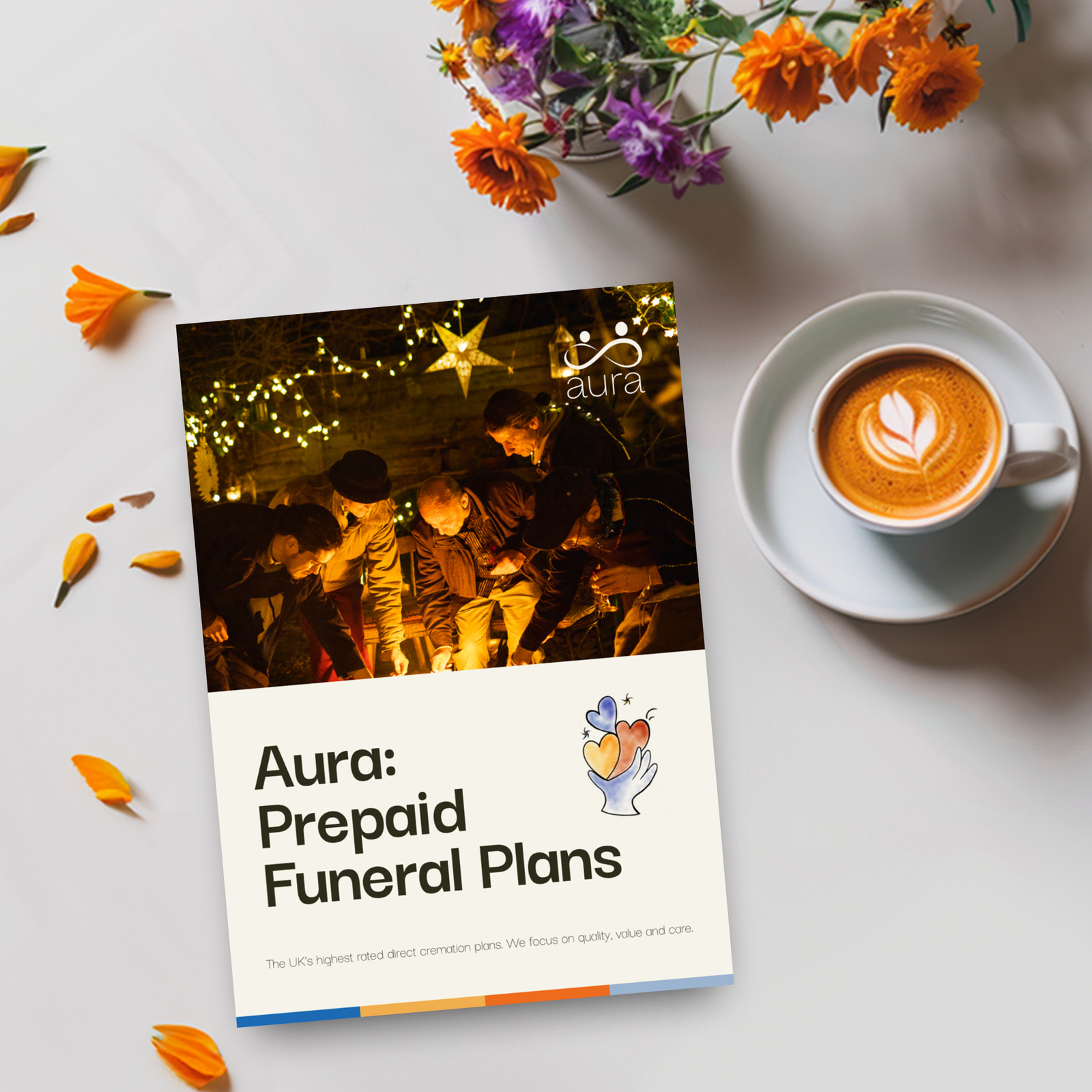
If you’d like to know more about how to plan a cremation with Aura, our brochure is a helpful place to begin.
Our funeral plans are a helpful way to put everything in place for you or someone else.
When the time comes, our experienced team will be here to guide you through each step, offering support and advice whenever you need it.
To find out more about how our plans work, what’s included, and our story, you can request a brochure by clicking the link below. We will then send you a copy by email or First Class post—whichever you prefer.
Death announcements are not typically sent out until the close family has been informed. Siblings, children, parents, and anyone else you know who is very close to the person who has died will generally be told in person or over the phone. Doing so can understandably feel daunting or overwhelming, but it is also a key part of coming to terms with what has happened. You may find that making these calls gives you a chance to begin processing your own emotions.
A traditional death announcement focuses on factual details such as the name, age, and location of the death of the person who has died. Keeping the language formal, concise, and respectful can allow you to provide a heartfelt yet precise message at what is likely a difficult time. More emotional tributes will generally follow later.
Social media has changed the way many of us communicate, with more and more people using it as a forum to share everything in their lives. One of the issues that this may create is that some still feel that a Facebook death announcement is too impersonal or casual when breaking the news to close family and friends. That said, the decision ultimately lies with the next of kin and what they know about their individual family dynamics and friendship groups.
Convention dictates that the next of kin contacts the closest relatives and friends with a phone call or meets them in person where possible. This is something that may feel overwhelming if you are still in a state of shock, but it can also provide you with the feeling that you have a support network and that you are not alone. Once you have contacted everyone you feel you should talk to personally, a death announcement is typically made to inform the wider circle.
A death announcement will include the name, age, and location of the death of the person who has died as well as a note that funeral arrangements will follow. If the death announcement has been delayed to the point where the arrangements have already been made, they will usually be added at the end. Some next of kin also request that any queries be directed towards another relative or close friend during the days after the death if they feel they need time and space.
The tone is important because it will dictate the way that many people learn of the death of someone in their lives. A formal, sombre, and respectful tone that focuses on conveying the facts is what may be appropriate here. If you are unsure about the specific choice of wording, you may wish to ask a friend who is already aware of the death to help you write it.
An email or text is acceptable, but you may wish to consider which people would appreciate a call or visit in person. The point here is that you will know what is appropriate in each case given your relationships with each person. Sometimes it can help to create a list of people you want to contact and then sit with it for an afternoon before making the calls. Taking your time and working through it one by one will ensure that you don’t hurt anyone’s feelings by sending them an email when a call may have been deemed more considerate.