×

Plan ahead and save up to £200 Save up to £200 on selected funeral plans until 31 October. T&Cs apply. Click here for full details.

Two Together: Save £100!Save £100 when you purchase two funeral plans together. Call us for more details.

Written by Emily Cross.
16 minute read

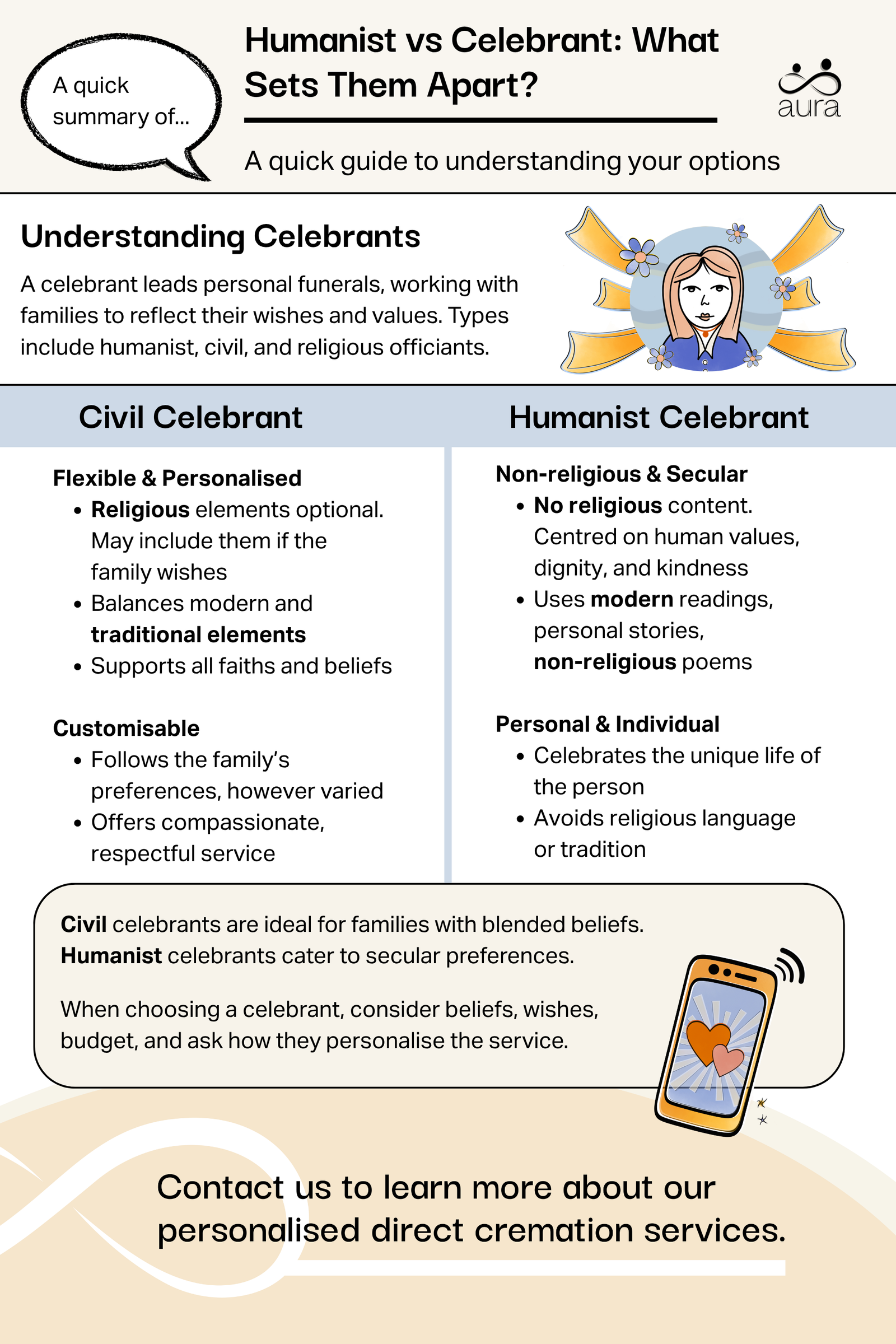
A humanist celebrant leads a fully non-religious funeral, without hymns, prayers or religious readings. An independent or civil celebrant offers more flexibility and can include religious elements if the family wishes. Both create personal ceremonies that reflect the life, memories and wishes of the person who has died.
When arranging a funeral, you may feel that a traditional religious service isn’t quite right for your loved one. Perhaps it doesn’t reflect their beliefs, or you’d simply prefer a more personal way to say goodbye. Whatever the reason, choosing a different approach can feel meaningful, but it may also leave you wondering where to begin.
One of the decisions you’ll need to make is whether to choose a civil celebrant or a humanist celebrant. Both can help you create a thoughtful, personal farewell, but their approaches differ, particularly when it comes to including religious elements.
In this guide, we’ll explore the differences between these funeral celebrants, what you can expect from each and how to choose the right person to help honour your loved one’s life.
Key takeaways:
A humanist celebrant leads a fully non-religious funeral that focuses on celebrating the life of the person who has died. Rather than following religious traditions, they create a personal ceremony built around the person’s values, personality and memories.
Humanist celebrants work closely with families to understand their loved one’s life and what made them special. They’ll then help shape a meaningful farewell through personal stories, modern funeral songs, non-religious funeral poems and readings.
A humanist funeral doesn’t include prayers, traditional funeral hymns or religious rituals. Instead, the ceremony usually focuses on:
There’s no fixed format, so families can help shape the ceremony around what feels most meaningful. Whether it’s a quiet gathering, a memorial service or a larger celebration of life, the celebrant will guide everyone through the farewell with warmth and care.
Humanist funerals can be particularly suitable for people who didn’t follow a religion or whose beliefs about death and funerals were centred on humanist values. If you’re wondering who conducts a non-religious funeral, a humanist celebrant is one option to consider.
An independent or civil celebrant also creates and leads personal funeral ceremonies, but they generally offer more flexibility when it comes to religious content.
Unlike a humanist celebrant, an independent celebrant can include prayers, hymns or religious readings if the family wishes. This makes them a suitable choice for families who want a largely non-religious service while keeping certain elements of faith or tradition.
An independent or civil celebrant can help families create a farewell that brings together different beliefs, traditions and personal wishes. Depending on the celebrant and the family’s preferences, this might include:
Independent celebrants can be particularly helpful when family members have different religious beliefs or when the person who has died wasn’t especially religious but still valued certain traditions.
Both types of celebrant aim to create a thoughtful, personal farewell. The main difference is that a humanist celebrant keeps the ceremony entirely non-religious, while an independent or civil celebrant can include religious elements if you’d like them.
Although humanist and civil celebrants both create personal funeral ceremonies, there are a few important differences to consider when deciding which is right for your loved one.
The main difference is whether religious elements can be included. Humanist celebrants lead entirely non-religious ceremonies, while civil celebrants can incorporate prayers, hymns or religious readings if the family wishes.
For example, if the person who has died wasn’t religious but their family would find comfort in including a favourite hymn, a civil celebrant may be the better choice.
If you’d prefer a ceremony without any religious references, a humanist celebrant can help create a farewell that reflects those wishes.
Both humanist and civil celebrants can create a service that feels warm, personal and meaningful. The tone doesn’t have to be formal or sombre, and families can choose how they want to remember their loved one.
A humanist ceremony may place particular emphasis on human values, relationships and the impact someone had on others. A civil ceremony can take a similar approach while also allowing space for religious or spiritual traditions.
Ultimately, neither option is more personal or meaningful than the other. The right choice depends on your loved one’s beliefs, the kind of farewell you’d like to arrange and what would bring your family comfort.
| Feature | Humanist Celebrant | Civil Celebrant |
|---|---|---|
| Religious content | No religious elements at all — no prayers, hymns or rituals | Can include religious content (prayers, hymns, rituals) if requested by the family |
| Tone of service | Warm, personal, reflective — centred on celebrating the life lived | Personalised and respectful — may lean spiritual or neutral depending on wishes |
| Structure | Fully customised; no fixed format or traditions | Also flexible, but may follow light traditional cues if preferred |
| Common venues | Crematoriums, natural burial grounds, gardens, homes, community venues | Same as humanist celebrants — very flexible |
Choosing between a humanist and a civil celebrant comes down to your loved one’s beliefs and the kind of farewell you’d like to arrange. Both can create a personal, meaningful ceremony, so it’s worth thinking about which approach feels right for your family.
If the person who has died specifically wished for no religion at all, a humanist celebrant is likely to be the most suitable option. They’ll create a fully non-religious ceremony focused on the person’s life, values and memories, without prayers, hymns or religious rituals.
A civil or independent celebrant may be better suited to families who want more flexibility, particularly when:
Beyond religious preferences, it’s important to choose someone you feel comfortable talking to. A good celebrant will listen to your wishes, offer guidance and work with your funeral director to bring the ceremony together.
It can also help to consider practical details, such as availability, location and cost. Fees vary, so ask what’s included and whether the celebrant’s services are covered by your funeral arrangements.
If you’re considering different types of funeral, you may also want to explore the cost of direct cremation. Some families choose a direct cremation followed by a separate memorial, which can be led by a celebrant or by family members themselves.
Speaking with a celebrant beforehand can help you decide whether they’re the right person to guide your loved one’s farewell. You might like to ask:
You don’t need to have every detail decided before making contact. Celebrants are used to supporting families who are coping with grief, and they’ll understand if you need time to think things through.
Whether you’re experiencing a range of emotions or finding yourself reflecting on the stages of grief, choosing someone who listens and makes you feel at ease can help make planning a little less overwhelming.

In the UK, a funeral celebrant typically costs around £180 to £300, although prices can vary depending on their experience, location and the type of ceremony you’re arranging. Both humanist and civil celebrants generally charge similar fees, so the choice often comes down to the kind of farewell you’d like rather than the cost.
These fees typically cover meeting with the family, learning about the person who has died, writing a personalised ceremony and leading the service on the day. Some celebrants may charge extra for travel, additional meetings or more complex arrangements.
The cost of a funeral celebrant is usually separate from cremation or burial fees, although your funeral director may include it in their overall quote as a third-party expense. Before booking, it’s worth asking for a clear breakdown of what’s included. This can help you plan your budget and choose someone who feels right for your loved one’s farewell.
Finding the right celebrant can make a real difference to how personal and meaningful a funeral feels. Whether you’re looking for a humanist or independent celebrant, it’s important to choose someone who understands your loved one’s wishes and makes you feel comfortable.
A good place to start is by asking your funeral director for recommendations or searching online for celebrants in your area. You can also use the Humanists UK celebrant directory to find trained humanist celebrants, or explore independent celebrants through professional organisations such as the Association of Independent Celebrants.
When comparing celebrants, it’s worth considering:
Many celebrants offer an initial conversation, giving you the chance to ask questions and see whether they’re a good fit.
You don’t need to make a decision straight away. Taking a little time to find someone who listens, understands your wishes and offers gentle guidance can help you feel more confident about the farewell you’re planning.
When you decide that you want to do something non-traditional, it’s understandable if you start to think about the legal status of what you’re doing.
As with all types of funerals, there is no need for legal recognition. This makes the question of the legal status of humanist funerals in England, Wales, Scotland, and Northern Ireland something of a moot point.
While funerals do not require legal officiation — it’s the death certificate that legally recognises death — legal status can matter in the case of weddings. A wedding is different from a funeral because it’s the act of signing the marriage certificate in the presence of witnesses that makes the marriage legally binding.
The celebrant career pathway in the UK is clearly laid out and highly transparent. Training courses by Humanists UK, and other organisations, set out a clear set of professional standards that ensure every accredited celebrant is well-versed in all of the matters they will be dealing with.
Their training will typically involve things such as:
Although training is not a mandatory requirement, many diligent celebrants will choose to dive deeper into their chosen profession and commitment to lifelong learning and self-improvement exercises.
We want you to know that we are always here to help and that we can do so in a variety of different ways. We offer prepaid funeral plans for those looking to organise their affairs while they are still alive and we also have resources that compare funeral plans that may help you to clarify your thinking. As a family-run funeral provider with a passion for what we do, we are committed to connecting you with the help you need.
If you decide that you wish to follow the path of hiring a celebrant so that you can create a highly flexible, personal service, we can offer resources that will show you how to organise a low-cost cremation. It’s all part of our approach to direct cremations; our goal is to help you remember the person who has died in a way that feels right.
Humanist celebrants focus on conducting non-religious ceremonies that follow the principles and values of humanism. They do not include any form of religious ritual or tradition and are popular with those who want a secular service that welcomes everyone who wishes to pay their respects and mark a death. Their services are highly personalised and not constrained by the traditions that may typically be present in a religious service.
A civil celebrant also offers a highly personalised and inclusive service, but they may also include religious elements at the direction of the family. They aim to follow the wishes of the family down to the finest detail and deliver a service befitting the memory of the person who has died.
A humanist is someone who lives by values such as reason, kindness and compassion, without following any religion or belief in the supernatural. Humanists tend to see meaning in life through human connection and shared experience, rather than faith or spiritual teachings.
Humanist celebrants are trained professionals who deliver funeral services that are personalised, flexible, and free from any form of religious tradition. They may be chosen by families who are religious, undecided, humanist, or atheist and are known for their flexible approach.
This very much depends on the type of service you want to have and the feelings of the person who has died. If they identified as a humanist or expressed a strong wish for no religious elements, a humanist celebrant may be the right choice. If you want to focus more on a personal service that has the option to include select religious elements, you may find that you feel more comfortable with a civil celebrant.
Yes, a celebrant will take pride in delivering a flexible and adaptable service that meets the needs and wishes of the family. A family who wants to add religious elements to an otherwise non-traditional service will typically hire a civil celebrant rather than a humanist celebrant, as the latter will chiefly focus on services free from religious elements.
If you are marking the life and death of someone who is not religious, whether they were agnostic or a staunch atheist, you may find that a humanist funeral feels right. By removing the religious elements and delivering a secular service, you may be able to adhere to the final wishes of your loved one. Other families may simply decide that they have no strong feelings about religion either way and wish to have a flexible approach that is highly personal.
Both types of celebrants will be compassionate and caring individuals experienced in getting to know the person who has died by talking to the family and next of kin. They listen to the wishes of the family, present ideas on how they may wish to personalise the service, and work to create an order of events that is aligned with the initial discussions. They will also be used to dealing with people who are grieving and will know that a soft touch and a listening ear can be needed at what is a difficult time.
Yes, a civil celebrant will work with people of different faiths and those of no faith. A humanist celebrant will typically focus on delivering services for people who view themselves as humanists and those who are not religious. They offer flexible alternatives to traditional religious officiants for families who may feel that is not the right choice for them.
A humanist funeral, while free from any form of religious tradition or ritual, will typically follow a similar course with readings, music, and eulogies forming the major components. The point here is that the celebrant will allow the family to change and adapt this standard starting point any way they wish, allowing for a more personal service than one that is more traditional.