×

Plan ahead and save up to £200 Save up to £200 on selected funeral plans until 31 October. T&Cs apply. Click here for full details.

Two Together: Save £100!Save £100 when you purchase two funeral plans together. Call us for more details.

Written by Emily Cross.
15 minute read

A civil celebrant is an independent professional who creates and leads personalised ceremonies, including funerals. Rather than following a particular religion, they shape the service around the wishes of the person who has died and their family. Unlike a humanist celebrant, they can also include religious elements, such as hymns, prayers or readings, if requested.
Planning a funeral for someone you love can be difficult, especially when you’re trying to find a way to say goodbye that feels true to who they were. You may want to include personal touches while keeping certain traditions that are meaningful to your family.
This is where a civil celebrant can help. By taking the time to understand your loved one’s life, personality and beliefs, they can work with you to create a ceremony that feels both personal and respectful, whether that’s entirely non-religious or includes some religious elements.
In this guide, we’ll explore what civil celebrants do, how they differ from other funeral celebrants and who can conduct a non-religious funeral. We’ll also explain what to consider when choosing someone to lead a service that feels right for you and your family.
Key takeaways:
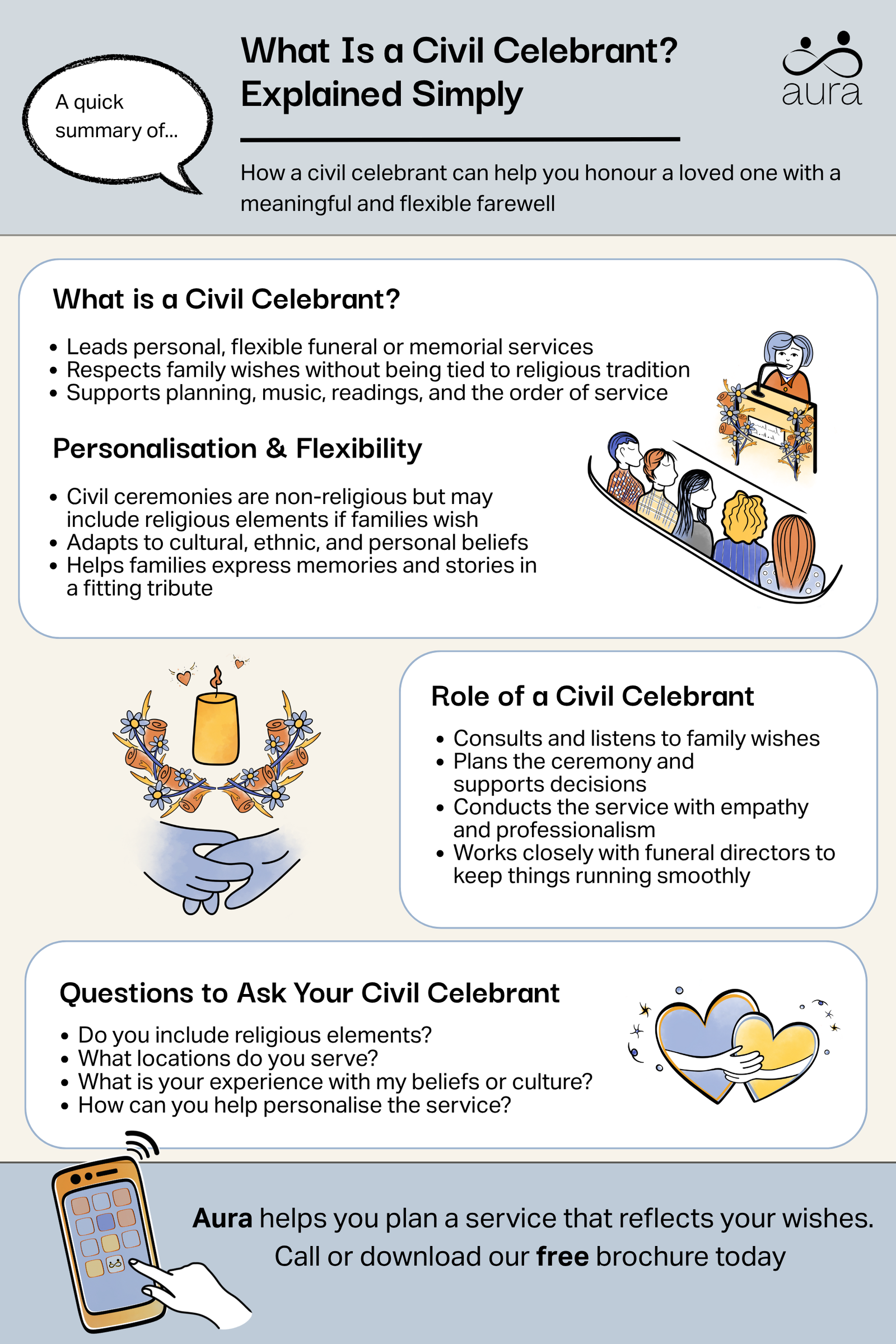
A civil celebrant can help families plan and organise a funeral or memorial service, offering guidance and support with the details that make the ceremony meaningful.
They can help you choose music, funeral poems and readings, decide who will speak and put together the order of service. They’ll also help manage timings and make sure everyone involved knows what to expect on the day.
Having someone to guide you through these decisions can be reassuring, particularly when you’re grieving. A civil celebrant can suggest ideas, bring together different family wishes and help the ceremony run smoothly.
You may also come across the term humanist celebrant. While both offer personalised ceremonies, humanist celebrants lead non-religious services. They may include popular funeral hymns or music with religious associations for personal reasons, but they don’t include prayers or religious rituals as acts of worship.
Civil celebrants, on the other hand, can incorporate these elements if the family wishes. If you’re unsure which approach would suit your loved one, our guide to humanist and civil celebrants explains the differences in more detail.
A civil funeral is a personalised ceremony that celebrates and remembers the life of someone who has died, without following a set religious format. It usually focuses on the person’s life, values and relationships, although religious elements can be included if the family wishes.
For families looking for a more modern funeral, a civil ceremony offers the freedom to choose how they’d like to say goodbye. It can be a quiet, reflective gathering or a more uplifting occasion filled with shared memories.
There’s no fixed order for a civil funeral, but many follow a simple structure of welcome, personal tributes, readings, music and a final farewell.
Each part can be adapted to reflect your loved one’s personality. You might choose modern funeral songs, live music or fun and uplifting funeral songs that bring back happy memories. Non-religious funeral poems, favourite stories and personal readings can also help make the ceremony meaningful.
A civil celebrant can guide you through these choices and help bring everything together into a service that feels natural and respectful.
Civil funerals can take place in a range of settings, including crematorium chapels, natural burial grounds, community venues and, where suitable, family homes.
The right location will depend on the type of ceremony you’re planning, the number of guests and any practical arrangements for the burial or cremation.
This flexibility can be especially helpful when bringing together different beliefs and family wishes. You may want to include elements of British funeral traditions while creating a ceremony that feels more personal to the person you’re remembering.
| Civil celebrant | Humanist celebrant | Religious officiant |
|---|---|---|
| Flexible, may include religious or spiritual elements at the family’s request, not tied to specific belief system. | Non-religious, focuses entirely on life and values of the deceased, no religious rites though family cultural elements may be included. | Linked to a specific faith tradition, will typically follow that tradition’s rituals and may have less flexibility for non-religious personalisation. |
Tip: If the person who died had mixed beliefs or the family wants some tradition plus personal touches, a civil celebrant can offer the best of both worlds.
A civil funeral celebrant supports families throughout the planning process, from the first conversation to the funeral itself. Their role is to listen, offer guidance and help create a ceremony that reflects the life and wishes of the person who has died.
Here’s what you can usually expect before, during and after the service.
Having a civil celebrant to guide the ceremony can offer reassurance, allowing family and friends to focus on remembering their loved one rather than worrying about how the service will unfold.
Finding the right civil celebrant is about choosing someone you feel comfortable with and who understands how you’d like to remember your loved one.
You can find an independent celebrant through professional organisations such as the Association of Independent Celebrants (AOIC), the Institute of Civil Funerals (IoCF) or the UK Society of Celebrants. These organisations can help you find celebrants who have completed training or follow professional standards.
You can also ask your funeral provider for a recommendation. With Aura, our team can help families find an AOIC celebrant to lead an attended cremation ceremony, taking one more decision off your shoulders.
Before choosing someone, it’s worth arranging an initial conversation to see whether they’re a good fit for your family.
You might want to ask:
A good celebrant will take the time to listen, answer your questions and explain how they’ll support you throughout the process.
You don’t have to find a civil celebrant on your own. Many funeral providers can recommend someone experienced in leading the type of ceremony you’re planning.
The celebrant will focus on preparing and leading the service, while the funeral provider takes care of the practical funeral arrangements.
Whether you choose someone independently or through a provider, it’s worth checking their availability, fees and what’s included before making a booking. What matters most is finding someone who makes you feel heard and helps you create a fitting goodbye.
Our guide on the price of funeral celebrants may be helpful at this point. We have also created some resources on arranging a low-cost cremation that you may also find helpful to refer to when you feel ready.
While every service is different in terms of length, style, and location, it may be helpful for us to provide an approximate range of £180 to £300 or more. Each celebrant will be able to guide you through what they can provide and whether or not they have any tiered packages you may wish to consider.
As well as planning meetings, writing various parts, and leading the service, the civil celebrant will be able to guide you through your options in a way that never makes you feel like you’re being rushed into a decision.
In addition to the various tangible elements we’ve already touched upon, the chief role of the celebrant is to provide you with a way to personalise the service. They will be emotionally attentive to your needs, know when to give you space and time, and will be able to create a plan that makes you feel like you are always in control of the process.
The personal nature of the service a celebrant can offer is something many families may feel is a natural fit for them. With this in mind, you may wish to budget for hiring the services of a celebrant as part of drawing up a list of overall funeral costs and sorting out how to pay for a funeral. This can help you find the right balance at a time when you want to make sure your wishes are listened to.
When you are deciding that you wish to break with tradition, it is understandable if you have a thought in the back of your mind when it comes to the legal side of things. We’re here to clear this up so that you can plan a service or ceremony in a way that you feel is right.
Civil funerals are not legal processes in the way that marriages are and therefore do not require any form of registration. While a marriage is recorded by the signing of the marriage certificate during the ceremony, a death is recorded when the death certificate is issued, and this is not done at the funeral. Although the celebrants will liaise with funeral directors and crematorium staff with respect to timings and logistics, they play no role in the official death registration.
In many ways, the role of celebrants is split between providing a comforting source of support and focus for the family and coordinating with funeral professionals to ensure everything goes as expected. For the service to flow smoothly from one stage to the next, and for everyone in attendance to feel like their needs have been met, the celebrant must exhibit clear communication at all times. They have a responsibility to make sure that all parties involved understand how the service will unfold and what is expected of them.
In our experience, taking a personal approach to remembering someone you love may help provide support with grief and death. Some families find it helpful to combine this type of personal approach with options such as our direct cremation services so that they create a non-traditional funeral or memorial without being quite so tightly bound by tradition. And if you are thinking about how to structure your own affairs when you die, you may find that our prepaid funeral plans are helpful, too.
We hope you have found some words of comfort and support in our guide and want to let you know that we are always right here when you need us. As a family-run funeral provider that cares about doing the right thing, we’re always looking for ways to make our industry more accessible and more comforting to people from all walks of life.
Explore our online resources today and you’ll find guides that compare funeral plans, articles that lay out direct cremation prices, and dozens of other pieces of content we hope are helpful. When you need us, we are always right here.
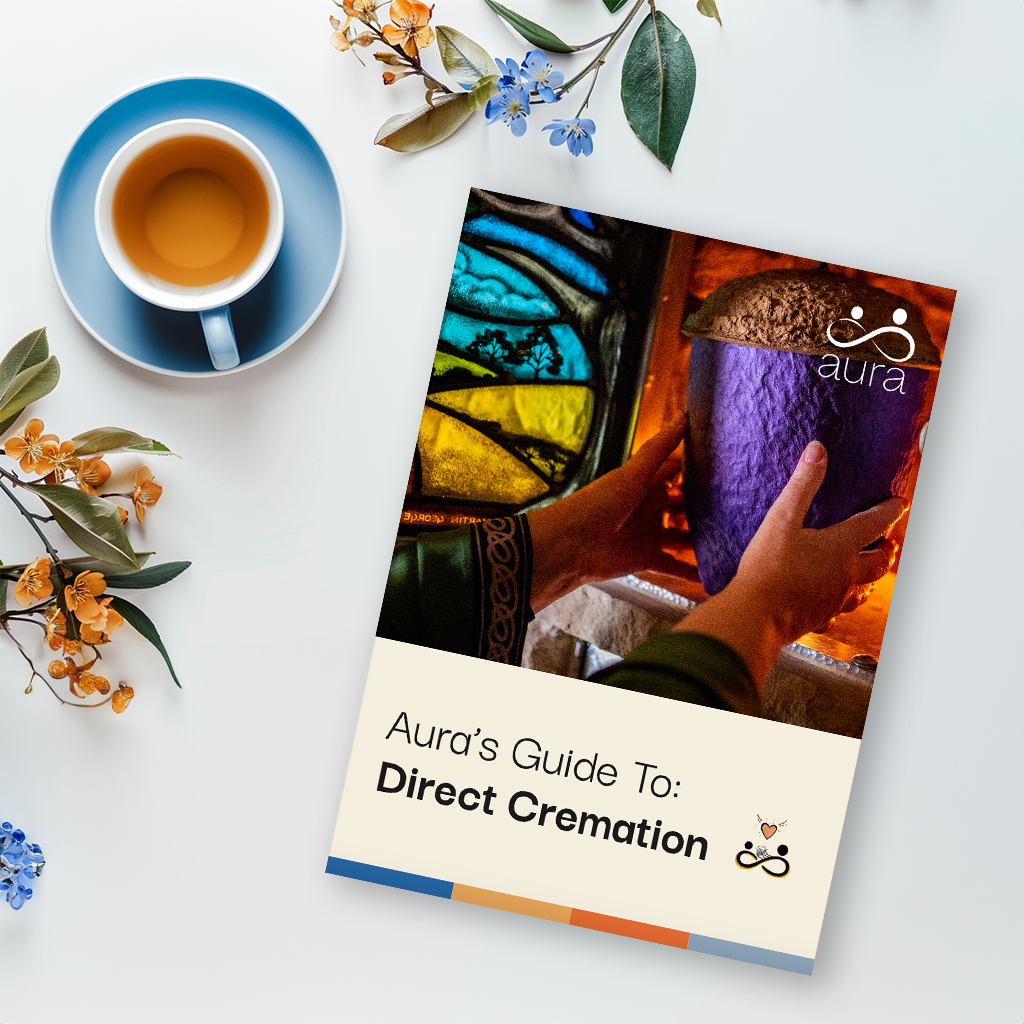
If you’d like more information about direct cremation and Aura’s funeral plans, then our downloadable guide can help. Find out why others are choosing this affordable, no-fuss alternative to traditional funerals and why it might be right for you too.
Download our guide by clicking the link below and learn more about this simple funeral plan option.
A civil celebrant is a professional person who can lead a personalised funeral ceremony or a non-religious funeral ceremony. They are an alternative to the traditional choice of religious officiants and are chosen by some families who feel they better reflect the beliefs and preferences of the person who has died.
Organisations such as The Celebrant Directory and the Association of Independent Celebrants allow you to search by location, ceremony type, and price. Finding a local celebrant that you can meet with in person prior to the funeral service may help you feel more comfortable and aligned with the process.
Civil celebrants can conduct a wide range of milestone events such as symbolic weddings (they are not legally binding), vow renewals, funerals, pet funerals, and naming ceremonies. Choosing a civil celebrant, rather than a religious officiant, is something some families feel better reflects the thoughts and feelings of the person who has died.
While a civil celebrant can conduct a wedding, the ceremony is purely symbolic in England and Wales and will not result in a legally binding marriage recognised by UK law. For this to be the case, the couple must also attend a registrar’s office to sign the required legal paperwork. That said, wedding ceremonies in Scotland and Northern Ireland that are directed by a humanist celebrant do result in a legally binding marriage.
The role of the civil celebrant in the preparation for the service is to speak with the family and learn everything they can about the thoughts, personality, and final wishes of the person who has died. They will use this information and further guidance from surviving family members and close friends to create a ceremony that tells a story that aligns with the wishes of the family. Much thought is given to choices such as the songs, music, readings, and poems that may form part of the service.
Prices will vary by location, the length of the service, and the specific choices of the family. You can view typical celebrant prices online and connect with a celebrant if you so wish. You may find that taking your time so that you can reflect on how you would like the service to take shape allows you to clarify your thinking. It is understandable to be caught in several minds at a time when you are also processing grief and coming to terms with the death of someone you love.
Yes, many civil celebrants choose to conduct both types of services while others prefer to focus on one or the other. Finding someone you feel comfortable with and who has experience in conducting funerals will allow you to say goodbye to the person who has died in a way that you feel befits their memory.
A humanist celebrant leads non-religious funerals that focus on the life, values and personality of the person who has died. These ceremonies avoid any form of religious content, such as prayers, hymns or rituals. Instead, they use personal stories, music and readings chosen by the family. The tone is usually warm and reflective, with an emphasis on kindness, compassion and celebrating a life well lived.
A civil celebrant, on the other hand, offers more flexibility. Like a humanist, they will work with the family to create a personal and respectful ceremony. However, civil celebrants can include religious elements, such as a hymn or prayer, if requested. This may be a helpful option for families who want to blend personal touches with some spiritual or religious content.