×

Plan ahead and save up to £200 Save up to £200 on selected funeral plans until 31 October. T&Cs apply. Click here for full details.

Two Together: Save £100!Save £100 when you purchase two funeral plans together. Call us for more details.

Written by Emily Cross.
15 minute read

Article reviewed by Judy Carole, Published Author on May 8, 2025.
If you’re reading this, you might be in the midst of grief…or supporting someone who is. Whether you’ve lost someone recently, are being a good friend, or you’re planning ahead, it can feel overwhelming trying to figure out where to begin. At Aura, we understand how difficult these moments can be. Planning a funeral isn’t just about logistics — it’s about honouring a life and creating space for connection, comfort, and remembrance.
A funeral order of service can help bring those elements together. More than a schedule for the day, it can reflect the person’s story, values and the memories they leave behind. In this guide, we’ll share order of service examples to help you create something meaningful and practical, whether you’re arranging a traditional funeral, a celebration of life or a simple cremation.
Key takeaways:
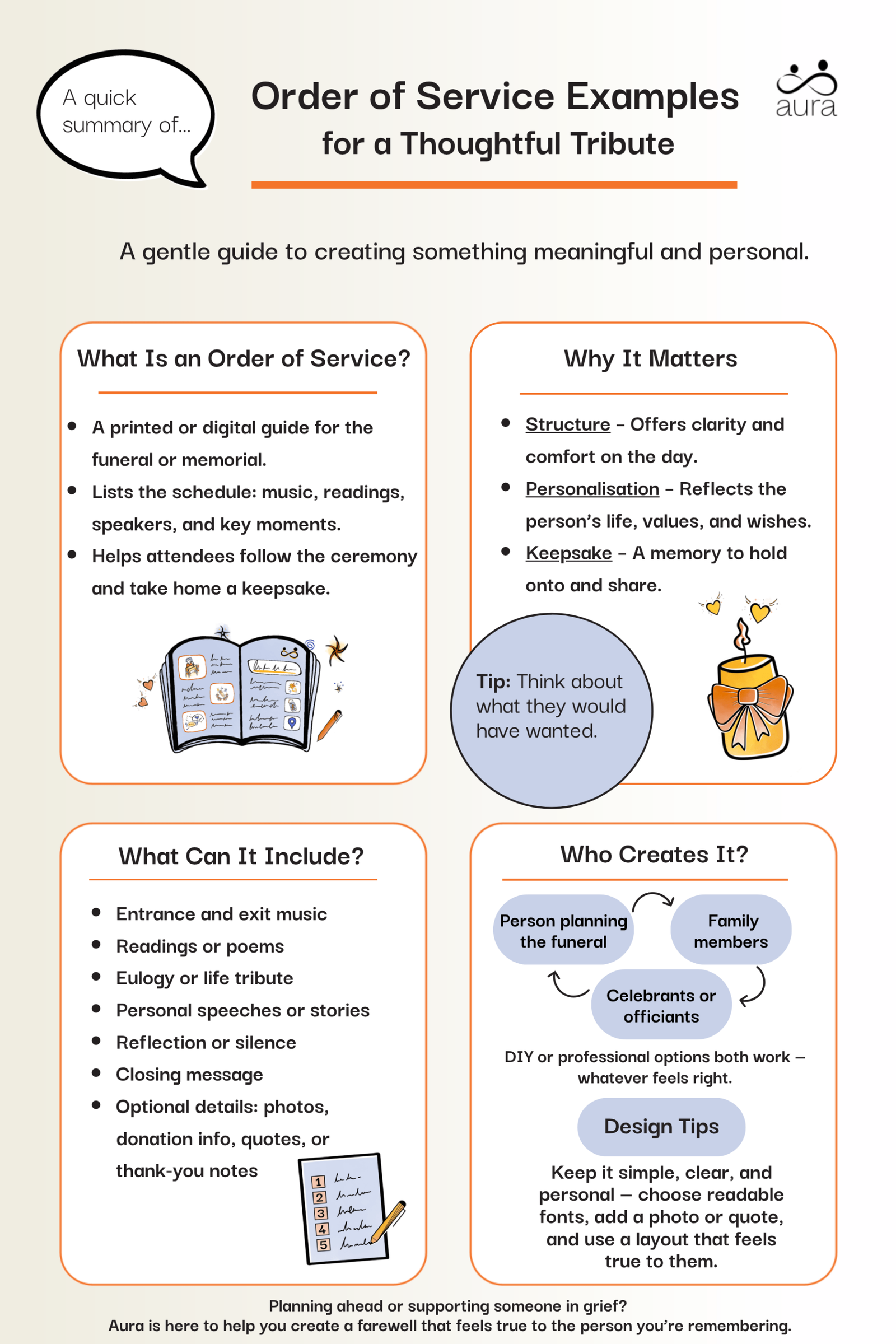
The order of service is a printed or digital programme that guides attendees through the funeral. It typically outlines each stage of the ceremony, including readings, music, and who is speaking when. Though it’s an optional element, many families find it brings clarity and comfort, offering a gentle guide through the emotions of the day, and helping people understand what happens at a funeral, especially if they’ve never attended one before. It also serves as a keepsake to take home and cherish.
For those wondering, ‘how much does a funeral cost?‘, it’s worth knowing that while an order of service can add to the expense, it doesn’t have to be elaborate to be meaningful—and some choose to create their own to keep costs low.
Whether it’s for a traditional church funeral, a memorial service, or a direct cremation followed by a private gathering, the order of service helps people come together to share in memory and mourning and to celebrate a life.
In most cases, the person arranging the funeral or memorial takes the lead on putting the order of service together. This is often a close family member, friend, or executor. But you don’t have to figure it all out on your own. This part of planning can be emotional, and there’s nothing wrong with asking for help.
If you’re working with an officiant or celebrant — such as a civil celebrant, who can blend secular and lightly religious elements — they’ll often assist with the layout, wording, and printing, or connect you with someone who can. You might also find it helpful to involve other family members… for example, one person choosing the music, another writing a short biography, and someone else proofreading or designing the layout.
A traditional order of service is usually more formal and may follow established religious or cultural customs. A Christian funeral order of service, for example, commonly includes hymns, scripture readings, prayers, a eulogy and the committal. This is a typical funeral order of service and reflects the standard structure used for many religious and traditional services.
This is a typical funeral order of service and reflects the standard funeral order of service used for many religious and traditional services.
Religious funerals often follow a well-established structure shaped by centuries of custom. These ceremonies can offer a sense of familiarity and spiritual grounding, which can be comforting and grounding for families.
For example, Christian services usually include hymns, scripture readings, and prayers — often drawn from a church’s funeral liturgy. Catholic funerals may also include a Mass. In Jewish tradition, funerals are typically held quickly after death, with readings from the Psalms and the Mourner’s Kaddish. Islamic funerals are often simple, solemn occasions, with specific rites such as ritual washing of the body, collective prayers (Janazah), and a swift burial.
Each faith has its own language of mourning and remembrance, and the order of service plays a key role in guiding attendees through that journey. Because these traditions are very meaningful and sometimes nuanced, it’s wise to work closely with a faith leader or an experienced funeral director. They can help you honour beliefs respectfully, and ensure everything is carried out with care and cultural sensitivity.
Non-religious and humanist ceremonies offer plenty of flexibility, focusing on the person’s life, relationships and memories rather than religious beliefs. A humanist funeral order of service follows the same structure without religious content, and the ceremony is usually led by a humanist celebrant.
Here’s an example:
These ceremonies often feel more like a celebration of life, blending grief with gratitude and shared memories.
An order of service for a cremation helps guide mourners through the ceremony, including the music, readings, tributes and committal. A cremation order of service can be religious, secular or somewhere in between, depending on the wishes of the person who died and their family.
The order of service at a crematorium is often more tightly structured than at a church or memorial because crematorium services usually run to a fixed time slot. The committal also has a defined place near the end of the ceremony, when the coffin is formally committed for cremation.
A typical structure might include:
For a smaller intimate funeral, the structure may be shorter and simpler, while a longer attended cremation can allow more time for readings, music and personal tributes.
A celebration of life order of service can be much more flexible than the programme for a traditional funeral. Rather than following a formal structure, it can centre on the person’s character, relationships, interests and the memories people shared with them. Celebrations of life may take place after a cremation or burial and can be held in a hall, garden, pub or another meaningful setting.
Here is a sample order of service for a celebration of life:
The wording for a funeral order of service should be clear, warm and sincere, while reflecting the tone of the funeral and the person being remembered. Keep it simple and consider the emotional state of attendees. A formal religious service may call for more traditional language, while a relaxed celebration of life might suit something conversational or even gently humorous.
Using this kind of language helps attendees feel more at ease, especially those unfamiliar with what happens at a funeral.
While the order of service mainly outlines the flow of the funeral or memorial, it can also be a place for heartfelt extras. Adding personal touches like a short life story, a favourite quote, or a meaningful lyric can help those attending feel more connected to the person they’re remembering.
Other optional additions include a message of thanks from the family, donation details for a chosen charity, or even instructions for what’s happening after the service like a wake or informal gathering. Some families include photo collages or tributes written by grandchildren. These details may be small, but they can leave a lasting impression and offer comfort long after the day is over.

Once you’ve decided what to include in the order of service, the next step is putting it together in a format that feels respectful, clear, and accessible. Whether it’s printed professionally or created at home, the design doesn’t need to be complicated, just thoughtful. Many families choose a favourite photograph for the cover, along with the person’s full name, date of birth and death, and perhaps a short phrase like In Loving Memory or A Celebration of Life.
Inside, the structure should be easy to follow. Use simple fonts and avoid overcrowding the pages. A 2–4 page folded leaflet is often enough for most services, depending on how many readings or songs are included. You might also want to include a brief biography or some words of thanks from the family. For printing, you can either ask your officiant or celebrant for help, if using one, use a local printer, or create a digital version to share online.
When it comes to the physical details, there are a few extra design choices that can make a big difference, both practically and emotionally.
Think about the texture and finish of the paper. Do you want something smooth and glossy, or would a more natural, textured paper feel more fitting? Some families choose recycled paper or minimalist digital formats for eco-conscious reasons–a great option if sustainability mattered to the person being remembered.
Before printing the full batch, you can ask for a proof copy to check layout, clarity and colours. This can help avoid last-minute surprises and gives you a chance to test for accessibility, too. If any guests are partially sighted or elderly, you may choose to opt for larger print sizes, clear fonts, and good contrast between text and background. Little details like these can help everyone feel included and supported and they show care in the quietest of ways.
If you’d like to see how different layouts, wording and imagery come together in practice, these funeral order of service examples offer real-world inspiration across a range of styles.
A few simple checks can help prevent unnecessary stress when preparing a funeral order of service:
Aura offers top-rated direct cremation services — simple, no-fuss funerals for people who prefer to keep things straightforward. Without the complexities of traditional funerals, families have the space to say goodbye in their own way.
With both attended and unattended options available, direct cremation offers flexibility to suit different needs. Some families choose a quiet, unattended direct cremation, no formal service, just dignified care and return of the ashes. Others may prefer to be present for a simple goodbye at the crematorium.
Either choice gives you space to plan a personal celebration of life later on — one that feels right, without the strain of time or tradition. It’s a thoughtful, low-cost alternative that still honours the person with care, compassion, and respect. Aura also offers prepaid funeral plans, and support with every step of funeral planning, including our funeral arrangements checklist to help families stay organised.
Whether you’re planning a traditional funeral, organising a memorial, or choosing a more modern direct cremation, what matters is honouring the person in a way that feels right.
And if you’re unsure where to begin, you’re not alone. Aura is here to guide you gently, helping turn a time of loss into a chance to reflect, remember and celebrate. If you’re in need of support, our team of experienced arrangers, known as Aura Angels, are just a call away.


Start by confirming the service details with the funeral director or celebrant, then:
Not necessarily. It’s an optional element, but many families find it helpful for guiding the day and giving guests something to hold onto and reflect on later.
Yes. Many people use simple templates or word processing tools to create a beautiful and personal programme. You can also ask your officiant, celebrant or a designer for help if you prefer something professional.
That’s completely fine. A celebrant, religious leader or close friend can read prepared words on your behalf. The service can also be shaped with readings, music, and moments of silence instead of spoken tributes.
Most funeral or memorial services last between 30–60 minutes, but there’s no fixed rule. It depends on what you want to include and the tone of the gathering.
Absolutely. A bit of lightness can offer relief and reflect the personality of the person being remembered. However, you may wish to be mindful to keep the tone gentle and respectful.
Most funeral order of service booklets are A5 and around 4–8 pages long. For a short service containing only the running order, a single card or folded sheet may be enough. Longer booklets work well when you want to include full hymn lyrics, readings, photographs or personal tributes. Bear in mind that adding more pages will usually increase the overall printing cost.